Elena's dashboard
Elena runs product development for a growing company. She is good at her job, and she has, without ever deciding to, tied her sense of being okay to her dashboard. When the numbers are green she feels grounded. When a customer review is harsh or a metric dips, something inside her drops through the floor.
Elena thinks she has a resilience problem. She does not. She has a reference-point problem. She is trying to stay steady by holding on to something that never stops moving.
You cannot measure against a moving thing
Here is the physics idea, and it is a simple one. You can only tell how something is moving by comparing it to something that is not. Sailors use a lighthouse, not another boat. If your only reference is another boat, and it is rocking too, you have no way of knowing which of you is moving, and every wave feels like your fault.
Most of us anchor our inner life to other boats. Praise. Income. Likes. The mood of the person in front of us. All of them move. So our inner state moves with them, and we call that anxiety.
The fix is not to stop caring about those things. It is to stop using them as your anchor.
Choose a reference that stays steady
Your state follows the noise
- Metrics, opinions and moods
- Your inner state wobbles with them
Your anchor holds
- Something that does not change
- A steadier inner state
Read the original text diagram
MOVING REFERENCE                     FIXED REFERENCE
[ metrics / opinions / moods ]  ↔    [ something that does not change ]
         ↕ wobble                              │ steady
[ your inner state ]                 [ your inner state ]
A point that does not move
In the Raja Yoga tradition the fixed point is the Supreme Soul, described as a point of light beyond time and decay. If that language speaks to you, use it: a few minutes each morning of quiet connection to something that never changes.
If it does not, the principle still holds. You need one reference that sits outside the daily weather. For many people that is a short list of what they stand for, and a few minutes at the start of the day, before any screen, to remember it. The point is not what you call the anchor. The point is that it does not move when the numbers do.
Elena did not need a thicker skin. She needed to stop asking her dashboard to tell her who she was.
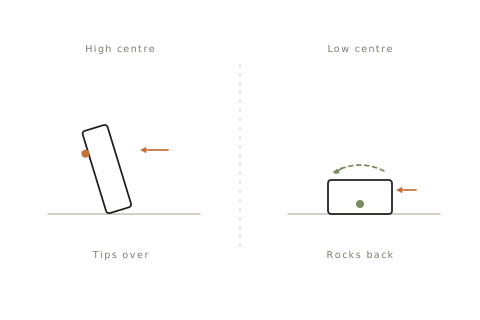
Heavy things are hard to knock over
The second idea in this chapter is about weight.
Physics says that objects with a lot of mass bend the space around them. A planet does not fight the things flying past it. It simply sits there, heavy, and their paths curve around it. Smaller things move around big things, not the other way round.
Your attention works the same way. When it is scattered, you are light, and every passing storm carries you along. When it is gathered, you are heavy, and the storm has to go around you. The original manuscript puts it in one line:
“A mind with zero mass is entrained by every passing storm. A mind of infinite density forces the storm to entrain around it.”
In plain words: a scattered mind is dragged along by whatever is loudest. A gathered mind makes the loud things route around it.
This is what the book means by inner mass, or inner groundedness. It is not a personality type. It is the result of two things you can practise: keeping your attention gathered rather than spread, and anchoring it to a point that does not move.
Try this: the morning anchor
- Before you look at any screen, sit for two minutes.
- Pull your attention away from the room, the day, and yesterday. Let it settle behind your eyes.
- Bring to mind your fixed point, whatever that is for you: the Source, or the two or three things you will not trade.
- Say, silently, one sentence: "My baseline is anchored to something that does not move. What happens today cannot change it."
Then open the phone. Notice how differently the first message lands.
Key takeaways
| Idea | In plain words | What it means for you |
|---|---|---|
| Reference point | The thing you measure yourself against | If it moves, you wobble. Choose one that does not. |
| Inner mass | Inner groundedness | Gathered attention makes you heavy enough that storms go around you. |
| The Source | A fixed point beyond the daily weather | A few screen-free minutes each morning to remember what does not change. |
Real-world example
A founder checks revenue before he is fully awake. If the number is up, he feels powerful. If it is down, the whole day sags before it starts. This chapter helps him separate performance from identity. He builds a two-minute morning anchor before opening any dashboard, and over time the numbers still matter, but they no longer decide whether he is inwardly steady.
What changes in you
- You stop tying your peace to metrics, moods, and praise.
- You create a fixed inner reference point before the outer day begins.
- You become harder to knock over because your baseline stops moving with every result.
With a centre in place, friction stops being a threat. The next chapter shows how to read it as information instead.