Part I: The Mechanics of Exhaustion · Free to readChapter 1 of 11 · 5 min read
Why You Feel Scattered
Core idea
Burnout is not a character flaw or a lack of willpower. It is what happens when your energy is pushed in too many directions at once.
Human takeaway
Learn why trying to do everything at once leaves you vibrating in place, and how to stop splitting your attention.
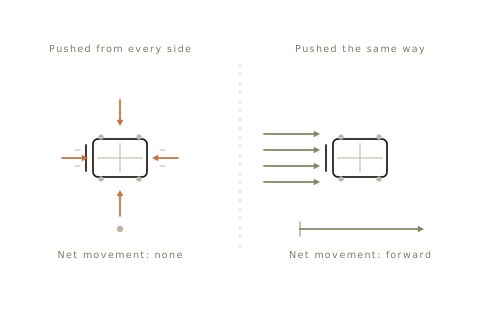
The idea, illustratedThe same four pushes, arranged two ways. Pushed from every side, the trolley shakes and goes nowhere; pushed the same way, it moves. Attention works like this: the effort is real either way, only the direction differs.Plain-language version
A Tuesday at 4:15 PM
It is 4:15 on a Tuesday afternoon. You are at your desk with fourteen browser tabs open, three unread message threads, two half-written documents, and a calendar reminder for a meeting that started four minutes ago. Your chest feels tight. Your focus feels paper-thin.
You tell yourself the problem is discipline. You make another coffee. You promise to download a better planning app tonight, or to start a new morning routine tomorrow. Underneath, you suspect the truth is worse: that you are simply not built for the pace of modern life.
You are wrong. What you are feeling at 4:15 PM is not a moral failure. It is mechanics, and once you can see the mechanics, you can change them.
The shopping trolley
Imagine four people pushing one shopping trolley. If they all push the same way, it rolls easily. Now imagine each of them pushing from a different side at the same time. The trolley shakes, the wheels squeal, everyone gets tired, and it goes nowhere.
Physicists call this splitting of force in different directions vector dispersion. In everyday words: pulling in every direction at once. That is what a normal working day does to your attention. A message pulls one way, an email another, a worry about tomorrow a third, an open tab a fourth. Each pull is small. Together they cancel out.
This is why you can be exhausted at the end of a day in which nothing moved forward. The tiredness is real. It is the heat of an engine spinning its wheels. You did not fail to try hard enough. You tried hard in twelve directions.
The physics word
In plain words
What it looks like in your day
Vector dispersion
Pulling in every direction at once
Fourteen tabs, three chats, one meeting. Lots of effort, no movement.
Spaghettification
Being pulled in a hundred directions until you feel thin
A small comment from a colleague feels like a personal attack.
Internal mass
Inner groundedness
The steadiness that lets small knocks bounce off instead of going straight through.
Stretched thin
There is a second effect, and it explains why small things start to hurt.
Near a black hole, the pull on the near side of an object is much stronger than the pull on the far side, so the object gets stretched into a long thin thread. Astronomers, with a straight face, call this spaghettification. You do not need the astronomy. You need the picture: something whole being pulled until it is thin.
When you live entirely on the outside of yourself, with your energy poured into screens, expectations, and other people's urgencies, your sense of who you are gets stretched in exactly this way. And a thin thing is fragile. A change of plan, an offhand remark, a traffic jam: none of these should be catastrophes, but when you are stretched thin they tear straight through you.
You are not too sensitive. You are too thin. You lack the inner weight that would let those knocks bounce off.
What the tortoise knows
Long before anyone measured a force, contemplative traditions noticed this problem and offered a fix. In the Raja Yoga tradition the picture is a tortoise.
When a tortoise senses trouble, it does not argue with the trouble. It does not try to rearrange the field it is standing in. It pulls its limbs into its shell. The noise can bang against the shell, but it cannot reach the living creature inside. When things settle, the tortoise comes out again, not in a panic but by choice.
That pulling-in is the first of the eight powers this book teaches: the power to withdraw. It is not running away. It is bringing your attention back to your own centre so that it stops being split across a dozen pulls. Everything else in this book builds on it.
See the idea
Bring your attention back to centre
01Outward
Pulled by every ping
Attention spread across demands
Every threat invites a reaction
Thin and easily unsettled
02Inward
Gathered at your centre
Attention brought back to one place
A pause before you respond
Steadier and less easily moved
The shift is in where your attention goes. Practise gathering it before choosing your next action.Read the original text diagram
OUTWARD (stretched)                 INWARD (gathered)
attention out on every ping    →    attention pulled to centre
reacts to every threat         →    protected by inner weight
thin, easily knocked over      →    dense, steady, hard to move
Try this: the 30-second pull-back
You do not have to take any of this on trust. Here is a test that takes half a minute.
Before you start, notice your body. The small tension in your jaw. The speed of your breathing. The background hum of things you need to do after this page.
Close your eyes. For thirty seconds, put down every task. Not solved, just put down. Then imagine every stray thread of your attention being drawn back to the centre of your chest, the way a star pulls scattered gas back into its glowing core.
Open your eyes. Did your breathing slow? Did your shoulders drop? Did the next thirty seconds feel slightly more spacious?
Nothing in your to-do list changed. Your inner state did, and it changed instantly, because you stopped spending energy in twelve directions. That is the whole book in miniature.
Key takeaways
Idea
In plain words
What it means for you
Pulling in every direction
Effort split across many demands cancels itself out
Fatigue with nothing to show for it means your focus is split, not that you are weak.
Stretched thin
A scattered self is a fragile self
Small knocks hurt more when there is less of you holding the centre.
The pull-back
Bringing attention home to your centre
A daily thirty-second habit that restores steadiness on the spot.
Prime Mover
Being the cause of your day, not the effect of it
The goal of the book: you set the direction, the world stops setting it for you.
Real-world example
A product manager opens Slack, email, a planning board, and a half-finished proposal at the same time. By lunch, she has been busy for four hours and moved nothing important. After reading this chapter, she notices that the exhaustion came from force split across too many directions. She closes everything except the proposal, takes a thirty-second pull-back, and finishes the hardest paragraph before checking anything else.
What changes in you
You stop reading scattered energy as a personality flaw.
You begin noticing split attention before the day fully runs away from you.
You learn a short reset that brings your attention back under your own control.
Pulling attention back is only half the job. It needs somewhere steady to land. The next chapter is about finding a centre that does not move.
Deep version
The High-Entropy World & The Search for an Anchor
The same chapter in the original voice: the physics named in full, the Raja Yoga terms kept as taught by the Brahma Kumaris and interpreted by the author, the equations and diagrams as the author wrote them. Assembled from the manuscript drafts.
From the draft: Chapter 1 — The Physics of Scattered Attention
I. The Myth of the Broken Will
It is 4:15 PM on a Tuesday.
You are sitting in front of a high-resolution display, surrounded by the quiet hum of productivity. On your screen live fourteen open browser tabs, three unread message threads, two draft documents, and an urgent calendar invitation for a meeting that started four minutes ago. Your chest feels tight. Your focus feels paper-thin.
You tell yourself you need better discipline. You order another coffee, promise yourself you will download a new time-blocking app tonight, or resolve to try a new stoic morning routine tomorrow. You assume that your exhaustion is a personal failure—a defect in your willpower, a deficit in your drive, or a sign that you simply aren't built for the modern pace of life.
You are wrong.
What you are experiencing at 4:15 PM is not a moral failure, nor is it a weakness of character. It is simple, unyielding mechanics.
In classical mechanics, Newton’s second law of motion dictates that force (F) applied to an object produces acceleration (a) along the line of vector direction. If you apply a single, concentrated unit of force in one direction, the object moves with rapid momentum.
Now, imagine applying that same unit of force, but splitting it simultaneously across twelve different vectors pointing in opposing directions.
What happens to the object? It doesn't move forward. It vibrates violently in place, heats up due to internal friction, and remains completely stationary.
This is Vector Division of Force.
When your attention is divided across dozen different external demands, your net forward momentum collapses towards zero. The physical exhaustion you feel at the end of the day isn't from moving mountains; it is the thermal loss of an engine spinning its wheels against opposing forces.
You aren't burnt out because you are weak. You are burnt out because your focus is obeys the exact laws of physical dispersion.
II. The Event Horizon and Spaghettification
In astrophysics, when an object strays too close to the event horizon of a black hole, it encounters an extreme gradient in gravitational force. The pull on the near side of the object is infinitely stronger than the pull on the far side. The result is a violent, structural stretching known as spaghettification. The object’s physical integrity breaks down as its matter is stretched into a thin, fragile thread.
Original diagram Scroll across if needed →
[ THE INWARD CORE ] ─────────────► [ OUTWARD EXPANSION ]
(Dense, Quiet, Whole)             (Stretched Thin Across Noise)
Modern life acts as a distributed gravitational field. Every app notification, algorithmic feed, career expectation, and social obligation exerts a localized pull on your consciousness.
When you live continuously in a state of Outward Expansion—projecting your mental energy entirely into external environments—your consciousness undergoes spaghettification:
Your focus is stretched thin across multiple digital domains.
Your emotional stability becomes dependent on external inputs you cannot control.
Your sense of identity loses its central density, scattering into the ambient noise of your environment.
When your consciousness is thinned out across the event horizon, even minor friction feels catastrophic. A sudden change in project scope, an offhand critical remark from a colleague, or a minor traffic delay doesn't just bump into you—it tears straight through your thinned-out field.
You lack the internal mass required to absorb external shocks.
III. The Ancient Mirror: The Tortoise and the Shell
Long before humans understood gravitational fields or vector dynamics, ancient contemplative traditions recognised this exact mechanical failure—and offered a structural fix.
In classical Eastern metaphysics, particularly in the teachings of Raja Yoga, the human experience is described through the relationship between the Soul (the inner observer) and Prakriti (the physical world of form, noise, and action).
When the soul becomes over-identified with Prakriti, it loses its self-sovereignty. It becomes a puppet pulled by the strings of sensory inputs, societal demands, and temporary outcomes.
To explain how to reclaim sovereignty, ancient sages used a simple, vivid parable: The Tortoise.
Original diagram Scroll across if needed →
┌─────────────────────────────────────────────────────────┐
│                   THE TORTOISE MODEL                    │
├────────────────────────────┬────────────────────────────┤
│  OUTWARD EXPANSION         │  GRAVITATIONAL RETRACTION  │
│  • Limbs exposed to noise  │  • Limbs pulled to center  │
│  • Reactive to threats     │  • Protected by core mass  │
│  • Thin, vulnerable state  │  • Dense, sovereign state  │
└────────────────────────────┴────────────────────────────┘
When a tortoise senses danger, noise, or chaos in its environment, it does not attempt to fight the environment. It does not argue with the threat, nor does it try to manipulate the external terrain.
Instead, it executes a clean, mechanical maneuver: it retracts its limbs into its shell.
It collapses its active vectors. It pulls its physical sensory apparatus back to its dense, unshakeable centre. In that retracted state, the outer noise can bang against the shell, but it cannot touch the living core inside.
The tortoise does not retract out of fear or escape; it retracts to maintain structural integrity. Once the environment stabilises, it extends its limbs again—not as a panicked reaction, but as a deliberate choice.
This ancient practice of retraction is not spiritual imagination—it is the deliberate application of Internal Gravity. It is the conscious decision to pull your attention back from the event horizon before your energy is thinned into oblivion.
IV. The 30-Second Empirical Proof
You do not need to take this framework on faith. Because attention follows mechanical principles, you can prove it to yourself right now through a simple, testable experiment.
EXPERIMENT 01: Vector Collapse
Step 1: The Baseline (Scattered Vector State)
Pause for three seconds. Notice the current state of your body and mind. Notice the ambient micro-tension in your jaw, the rapid rhythm of your breathing, and the background mental chatter calculating what you need to do after reading this page. This is your current vector dispersion.
Step 2: The Retraction (Collapsing the Field)
Close your eyes. For the next 30 seconds, perform a deliberate act of Ontological Subtraction:
Mentally drop every task on your to-do list for the next 30 seconds.
Sever your attention from your screen, your room, your career, and your name.
Imagine pulling every stray line of your attention back into the exact centre of your chest, like a star pulling its scattered gases back into a dense, glowing core.
Step 3: The Measurement
Open your eyes.
Notice what happened in those 30 seconds:
Did your heart rate slow down?
Did the physical weight in your shoulders shift?
Did time feel slightly more spacious?
You did not gain extra hours in the day. You did not solve your workload. Yet, your internal state shifted instantly. Why? Because you stopped the thermal loss of divided vectors. You restored your internal density.
V. Slowing Time and Becoming the Prime Mover
When you live with low internal density, time feels like an enemy. It rushes past you in a chaotic blur of deadlines, pings, and reactive decisions. You feel like a passive object tossed around by the currents of a high-entropy universe.
In Einstein's theory of general relativity, time dilation demonstrates that time moves slower near objects of immense gravitational mass. The deeper the gravity, the slower the clock ticks relative to the chaotic space around it.
Original diagram Scroll across if needed →
  HIGH NOISE / LOW DENSITY ──► Fast, Frantic Time (Reactive)
  HIGH MASS / HIGH DENSITY  ──► Slow, Spacious Time (Sovereign)
The human mind exhibits an identical phenomenon:
When you collapse your scattered vectors and anchor your attention in your Inward Singularity, your perception of time expands. The gap between stimulus (the urgent ping, the crisis, the insult) and response opens up into a spacious, calm expanse.
Where a scattered mind reacts in panic within 50 milliseconds, a high-density mind operates in slow motion. You gain the clarity required to evaluate inputs, filter out social debris, and select your trajectory with absolute precision.
You cease to be a reactive object pushed by the environment.
You become the Prime Mover—the unshakeable source of your own trajectory.
The Key Takeaways of Chapter 1
Theoretical Concept
Physical Mechanism
Everyday Life Application
Outward Expansion
Vector Division of Force
Fatigue caused by splitting focus across multiple apps and demands.
Spaghettification
Tidal Stretching at Event Horizon
Feeling emotionally thin, reactive, and easily unseated by minor friction.
Gravitational Retraction
Collapsing External Vectors
Practising short, daily micro-retractions to restore core mental density.
Prime Mover Shift
Gravitational Time Dilation
Expanding the space between stimulus and response to act with sovereign choice.
In the next chapter, we will explore why maintaining this internal density requires an Invariable Reference Point—and how to anchor your mind to a source that never decays.
From the draft: The Inward Singularity — manuscript blueprint (Sella Yaso)
I. The Tuesday Morning Crisis
Consider Marcus, a lead software architect at a high-growth logistics firm. At 08:14 AM on a Tuesday, Marcus sits at his desk. His phone is vibrating with seven Slack notifications, two incoming emergency emails regarding a database outage, and a calendar invite for a meeting that overlaps with a critical deployment deadline.
Marcus feels his heart rate accelerate, his throat tighten, and his focus fragment across four different screens. He is not lazy; he is competent and ambitious. Yet, he feels pulled apart at the seams. Marcus believes he has a time management problem. He tries downloading a new task planner, batching his emails, and setting strict calendar blocks.
None of it works. Within two days, the tide of external demands washes away his system. Marcus is attempting to fix a fundamental physics problem with a surface-level administrative remedy.
II. The Mechanics: Entropy and Spaghettification
In thermodynamics, the Second Law dictates that all closed systems move naturally towards maximum disorder (Δ S > 0). In our modern digital landscape, the volume of incoming inputs, opinions, and notifications creates an environment of ultra-high entropy.
Original diagram Scroll across if needed →
                THE DYNAMICS OF SPAGHETTIFICATION

[ EXTERNAL ENTROPY (High Noise Field) ]
     │         │         │         │
     ▼         ▼         ▼         ▼
┌──────────────────────────────────────┐
│      LOW INTERNAL MASS (ρ → 0)       │
│  Attention stretched across vectors  │
└──────────────────────────────────────┘
     │         │         │         │
     ▼         ▼         ▼         ▼
[ SPAGHETTIFIED STATE (Zero Causal Force) ]
When a human mind operates with low internal mass density (ρ → 0), incoming external pulls exert strong tidal forces on its attention. In astrophysics, an object falling into a black hole experiences spaghettification—its mass is stretched into a thin string until its structural integrity collapses.
When your attention is stretched across twenty browser tabs, twelve projects, and dozens of notifications, your consciousness is spaghettified. You lose causal force because your mass is diluted across too large a surface area.
III. The Tactical Maneuver: The 5 Drag Layers
In Brahma Kumaris (BK) metaphysics, loss of inner density begins when consciousness shifts from soul-awareness (Purush) to body-consciousness (Dehbhan). In our operational framework, this dilution manifests across 5 Drag Layers:
Original diagram Scroll across if needed →
┌─────────────────────────────────────────────────────────────────────────────┐
│                           THE 5 DRAG LAYERS AUDIT                           │
├─────────────────────┬───────────────────────────────────────────────────────┤
│ Drag Layer          │ Operational Manifestation                             │
├─────────────────────┼───────────────────────────────────────────────────────┤
│ 1. Role Drag        │ Over-identifying with job titles, status, or rank.    │
│ 2. Opinion Drag     │ Needing to defend your stance in every room.          │
│ 3. Achievement Drag │ Relying on external metrics for internal validation.  │
│ 4. Outcome Drag     │ Anxiously gripping future results you cannot control. │
│ 5. Sensory Drag     │ Reacting to every ping, badge, and notification.      │
└─────────────────────┴───────────────────────────────────────────────────────┘
IV. The 30-Second Empirical Lab Test: The Mass-Loss Audit
Sit quietly and close your eyes.
Review your current active task list.
Identify which tasks are driven by Role Drag or Opinion Drag.
Mentally draw a line through them. Feel the immediate relief in your mental baseline as you step out of defensive positioning.