Time management is a surface remedy.The problem is where your attention goes.
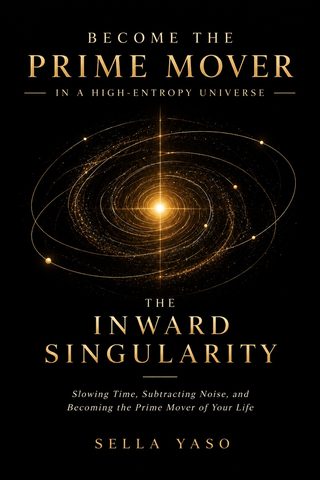
A book about attention, written in the language of physics: entropy for the pull in every direction, gravity for the centre you can return to.
For people who feel mentally scattered, overextended and pulled in too many directions. The physics is a metaphor for how attention behaves, not a claim about the mind, and no background in physics or meditation is needed.
Free to read in full, in plain language and in the author’s deeper voice. The PDF and e-book editions are on the book page, and the daily protocol is further down this one.
Three things to try
Three of the book’s arguments with the words taken away: four people pushing one trolley, a day drifting past, and three seconds before you answer. A minute each, and nothing to win.
The book in eight minutes
Start here if you have ever finished a day exhausted and been unable to name one thing you did. Eight minutes on why that happens, why another app or a better routine makes it worse, what the physics is doing in a book about attention, and the practice small enough to start tomorrow morning.
Take the book on a walk.
The whole Plain-Language Edition, read aloud, chapter by chapter. Nothing downloads until you press play.
You stop reading exhaustion as a personal failing
Not a time problem. An attention problem, with a diagnosis you can act on.
You get eight specific moves for noise, pressure and decisions
Withdraw from noise, close open loops, absorb pressure, decide cleanly.
Your day starts with a direction, not a notification
Begin anchored, reset at midday, close the day without mental residue.
“To change your reality, do not fight the world. Increase your mass. Anchor your centre. And let your gravity do the rest.”
The Daily Gravity Protocol
The philosophy becomes practical through a simple daily rhythm: begin anchored, reset at midday, and close the day without mental residue.
The Dawn Anchor
Fifteen to thirty screen-free minutes on waking. Put down yesterday, connect to your fixed point, and write one line: the single thing that would make today a success.
Midday Micro-Retractions
Sixty seconds on the hour. Step back, scan for tension, drop it, take one breath, and return to the one line.
The Evening Shutdown
Score four measures without emotion, write down every open loop, and put down every role before sleep. What is left unclosed becomes cosmic debris: small pieces of yesterday, still in orbit.
You do not need to share the philosophy to use the practice. The plain-language chapters keep the practices and set the spiritual vocabulary aside.
Your problem may not be time. It may be fragmented attention.
When your attention is constantly pulled by messages, demands, and noise, it becomes harder to think clearly, choose well, and stay rooted in yourself. This book argues that the answer is not better scheduling alone, but a stronger centre of attention and intention.
Why do we suffer?
Not because we are weak, and not because life is against us. We suffer because we live too far from our centre. When attention is scattered across roles, opinions and other people’s moods, every small thing pulls us off course, and that pull is felt as friction. The practices in this book close the distance.
A Prime Mover is someone who acts from their own centre instead of being moved by whatever arrives first.
Every term in the book is defined in plain language in the glossary.
Three parts, eleven chapters
The book moves in three stages: first diagnosis, then method, then daily practice.
The Mechanics of Exhaustion
Why You Feel Scattered · The Unshakeable Centre · Resistance Is Just Data
The 8 Sovereign Powers
The Art of Letting Go · Absorbing Shocks and Flowing Around Barriers · Filtering Noise and One-Direction Focus · Facing Pressure and Team Harmony · How to Slow Down Time
“I tried discipline, productivity apps, and better scheduling, but none of them solved the deeper friction. My suffering was not laziness or chaos. It was the friction of living too far from my centre.”
— Sella Yaso · the whole storyThe laboratory for the philosophy
Short, free essays that test the book's ideas against everyday life. Each one is a few minutes' read, and a new one arrives most weeks.
Read this if you feel scattered
- You feel mentally scattered, overextended and pulled in too many directions.
- You have tried better scheduling — sharper lists, a tighter calendar, another app — and found it did not reach the real problem.
- You are a professional, founder, creator, parent or leader carrying more than one role at once.
- You are willing to change one daily habit and watch what happens.
No background in physics or meditation is needed.
This book will not help if
- You want tactics for fitting more into a day.
- You want peer-reviewed neuroscience. The physics here is a descriptive language, not evidence.
- You are unwell or in crisis. This is written for people who feel scattered rather than ill, and it is not a substitute for proper care.
What readers ask first
What is The Inward Singularity about?
The Inward Singularity by Sella Yaso is a book about why you feel scattered and how to become steady. Its central metaphor is that burnout is not a character flaw but can be understood through the language of physics: when attention is pulled in too many directions at once, the effort cancels itself out. The book translates ideas from physics, such as mass, gravity and time dilation, into plain-language practices for regaining focus, making cleaner decisions and living from a steadier centre.
Who is this book for?
It is for people who feel mentally scattered, overextended and pulled in too many directions: professionals, founders, creators, parents and leaders who have tried better scheduling and found it did not reach the real problem. No background in physics or meditation is needed.
Is The Inward Singularity free to read?
Yes, completely. All eleven chapters are free to read online at inwardsingularity.com, in both versions and with no sign-in anywhere. Each chapter page carries the plain-language version first, then the deep version in the author's original voice, with the physics named in full, the equations, the diagrams and the Raja Yoga terms. Nothing is held back and nothing asks for an email.
Do I need to understand physics to read it?
No. The physics is used as a set of pictures, not as maths. A shopping trolley pushed from four sides explains scattered attention; a large pot of water that heats slowly explains why a steady person absorbs criticism; clocks that run slow near heavy objects explain why a calm mind seems to have more time. The equations are written out in the full edition; the plain-language chapters keep to the pictures.
Field notes from the centre
Get one short weekly essay on attention, stillness, and inner clarity. Thoughtful, practical, and never urgent.