Two kinds of trouble
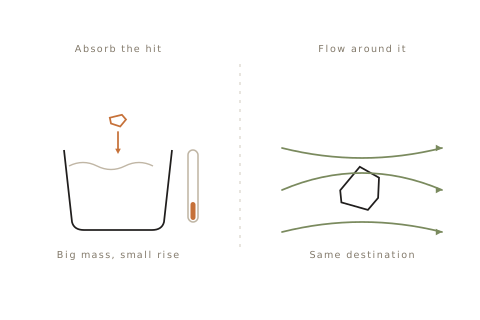
Trouble arrives in two shapes. Some of it hits you: bad news, a sharp comment, a sudden loss. Some of it blocks you: a rule that will not bend, a person who will not agree, a door that will not open. Hitting and blocking need different responses, and mixing them up is where most of the exhaustion comes from. People try to flow around a hit, and end up dodging what they should have absorbed. Or they try to absorb a block, and end up leaning on a wall for months.
The third and fourth powers are the answers to these two shapes. The original calls them the power to tolerate and the power to adjust.
Absorbing a hit: the big pot of water
Put a flame under a teaspoon of water and it boils in seconds. Put the same flame under a large pot and the temperature barely moves. Nothing about the flame changed. The pot has more mass, so the same heat spreads out and does less damage. Engineers call this thermal dissipation. In plain words: a bigger body warms slower.
Criticism is heat. When you are thin and scattered, a single remark boils you over. When you have gathered your attention and anchored your centre, the same remark spreads through a much larger you and hardly raises the temperature. You still feel it. You are simply not boiled by it.
Tolerating, in this sense, is not gritting your teeth. It is having enough of you present that the shock has somewhere to go.
| Absorbing badly | Absorbing well |
|---|---|
| Instant defence: "That's not fair, you don't understand" | Five seconds of silence, then: "Tell me more about what you saw" |
| Replaying the comment for the rest of the day | Noting the useful part, dropping the tone |
| Treating the person as an enemy | Treating the comment as data about one moment |
Getting around a block: how water moves
Now the other shape. A river meeting a boulder does not stop and argue with it. It does not push. It goes around, and it loses almost none of its momentum doing so. The original calls this fluid adaptability. In plain words: flow around what will not move.
The mistake here is the opposite of the last one. With a hit, people run when they should absorb. With a block, people push when they should flow. They spend weeks trying to move a policy, a person, or a fact that was never going to move, and they call that persistence.
Adjusting is not giving up on the destination. It is giving up on one particular path to it.
Which one is this?
A quick way to tell the two apart in the moment:
| Ask | If yes, it is a hit → absorb | If yes, it is a block → flow |
|---|---|---|
| Has it already happened? | Yes. The comment was made, the news arrived. | No. It is standing in front of me. |
| Can I change it by pushing? | No. It is in the past. | No. But I can change my route. |
| What does it need from me? | Enough weight to not be boiled | Enough flexibility to find another way |
Try this: one hit, one block
Pick one recent hit. Say out loud the one useful sentence inside it, and let the rest go. Then pick one current block, something you have been pushing against for more than a week. Name three other routes to the same destination. You do not have to take any of them yet. Just noticing that they exist is the adjustment.
Key takeaways
| Idea | In plain words | What it means for you |
|---|---|---|
| Tolerate | A bigger body warms slower | Gathered attention gives criticism somewhere to spread out. |
| Adjust | Flow around what will not move | Keep the destination, change the path. |
| Hit or block? | Two shapes of trouble, two responses | Absorb what has happened. Flow around what stands in your way. |
Real-world example
A consultant is criticised sharply in front of a client and then learns a key approval is blocked. Old habits would either harden into defensiveness or collapse into frustration. This chapter gives him two paired responses: absorb the emotional shock without splashing it outward, then reroute around the obstacle without losing the destination. The meeting ends cleaner, and the work keeps moving.
What changes in you
- You become less breakable when sudden pressure lands.
- You learn to keep your aim while changing your route.
- You stop treating blocked paths as proof that the whole mission has failed.
Absorbing and flowing handle what arrives. The next two powers handle what you choose to let in, and what you do with it.