Sarah adds another app
Sarah founded a company. She is tired in a way sleep does not fix. Her response, every time, is to add something: a new productivity app, a supplement, a morning routine from a podcast, a second planner to organise the first one.
Each addition helps for a week. Then it becomes one more thing to maintain, and the tiredness comes back a little heavier. Sarah is loading more onto a vehicle that is already over its limit.
Why rockets drop their tanks
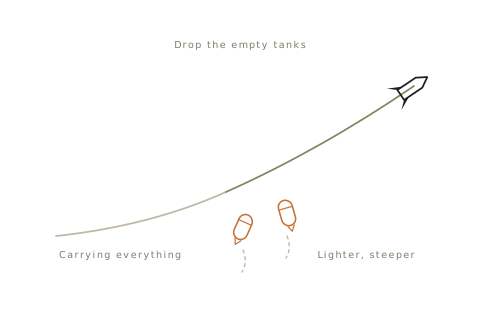
Rocket engineers face a hard rule. To go faster, you need fuel, but fuel is heavy, so adding fuel only helps up to a point. The way rockets actually reach orbit is by dropping weight. Empty tanks are jettisoned mid-flight. The lighter the vehicle, the further the same push takes it.
The original calls the personal version of this ontological subtraction. In plain words: ruthless simplification. You get more speed not from a bigger engine but from a lighter load.
Give the same effort less to carry
More things to maintain
- Existing tasks
- Another app
- Another routine
One core priority
- Drop unnecessary weight
- Direct your effort into what matters
Read the original text diagram
ADDING (fails)                       SUBTRACTING (works)
existing tasks                       one core priority
+ new app                    slow    [ dropped weight ]      fast
+ new routine                   →                              →
The five kinds of weight
Most of the load is invisible, because it is not on the calendar. It is in the roles and expectations you carry around all day. The original names five drag layers. Here they are in plain words, with a question for each.
| The weight | In plain words | Ask yourself |
|---|---|---|
| Role drag | Over-identifying with a title or status | Would I still do this if no one knew my job title? |
| Opinion drag | Needing to defend your view in every room | Does this argument change anything I will do tomorrow? |
| Achievement drag | Needing external scores to feel okay | Am I doing this for the outcome or for the applause? |
| Outcome drag | Gripping results you cannot control | Which part of this is actually mine to decide? |
| Sensory drag | Reacting to every ping and badge | Did I choose to look at that, or did it choose me? |
Notice that none of these are tasks. You cannot delegate them or schedule them. You can only put them down.
Purge and protect
A simple way to sort your week is to draw two columns.
| Purge (high drag, low value) | Protect (low drag, high value) |
|---|---|
| Meetings you attend to be seen | Uninterrupted blocks on the one thing that matters |
| Chat channels you cannot leave open without checking | Rest, and the morning minutes before any screen |
| Social obligations kept out of guilt | The two or three relationships that give energy back |
| Projects kept alive to prove a point | Work you would do even if no one noticed |
Everything in the left column is fuel you are burning to carry weight you do not need.
Closing the loops
There is one more kind of weight, and it is the one you take to bed. Open loops: the email you meant to send, the decision you half made, the conversation you are still having in your head. The second of the eight powers is the power to pack up. In plain words: close the loop, record the facts, and put it down.
This does not mean finishing everything. It means writing the unfinished thing down somewhere you trust, so your mind can stop holding it. A loop that is written down is closed for the night even if the task is not done.
Try this: the weight audit
- Sit quietly for a minute and bring your current task list to mind.
- Find three items that exist mainly because of role drag or opinion drag. Being honest here is the whole exercise.
- Mentally draw a line through them. Notice the small physical relief. That is the feeling of dropped weight, and it is available every day.
Key takeaways
| Idea | In plain words | What it means for you |
|---|---|---|
| Subtraction over addition | Drop weight instead of adding fuel | The next improvement to your life is probably something to remove. |
| The five weights | Role, opinion, achievement, outcome, sensory | None are tasks. All can be put down. |
| Purge and protect | Two columns for your week | Move fuel from the left column to the right. |
| Pack up | Close open loops by writing them down | A loop on paper is a loop your mind can let go of. |
Real-world example
A senior manager keeps saying yes to meetings, side projects, and obligations because each one seems harmless on its own. This chapter helps her see that the deeper problem is invisible weight: role drag, outcome drag, and open loops. She cancels two low-value commitments, writes down three unfinished threads before bed, and feels more relief from subtraction than she ever got from adding another system.
What changes in you
- You stop assuming growth always comes from adding more.
- You begin identifying the hidden weight behind fatigue.
- You start using subtraction, closure, and simplification as real forms of strength.
Lighter and more centred, you are ready for the powers that deal with what hits you from outside.