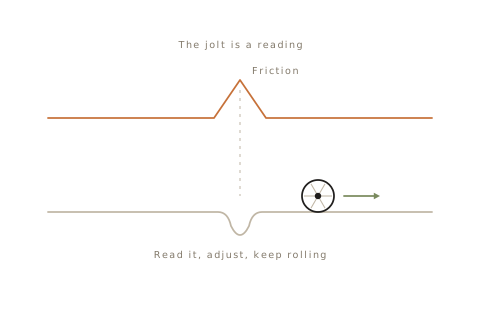
The pothole
You hit a pothole on the way to work. It jolts the car, you spill a little coffee, and for the next ten minutes you replay it: the council should have fixed that, you should have seen it, this is typical of your week.
Now look at what the pothole actually told you. There is a hole in the road at that spot. That is the whole message. Everything else, the ten minutes of replay, you added yourself.
This chapter is about the difference between the message and the replay. Most people spend ninety percent of their energy on the replay.
Friction is information
Engineers do not get angry at friction. They measure it. When a machine runs hot, that heat tells them exactly where two parts are rubbing. It is a signal, not an insult.
The obstacles in your day work the same way. A project changes scope. A colleague criticises your work in front of others. A plan falls apart. Each of these is feedback: something about your approach met something about the world, and there was resistance at that point. The resistance is the data. It shows you where to adjust.
The Raja Yoga tradition has a word for the way your actions shape your inner state: karma. In the original manuscript this is treated not as a ledger kept somewhere else but as immediate physics. In plain words: when you react with blame, defence, or resentment, you pay for it straight away, in the form of inner drag. Not next year. Now. The clenched jaw and the ten-minute replay are the bill.
| What happened | The message (data) | The replay (added by you) |
|---|---|---|
| A critical comment in a meeting | One person sees a weakness in the plan | "They never respected me. I should have prepared more. Everyone saw." |
| A project is cut | Priorities changed above you | "Three months wasted. This always happens to me." |
| A late train | You will arrive twenty minutes late | Twenty minutes of fury about the rail company |
How fast do you bounce back?
The most useful number in this book is not how often things go wrong. It is how long it takes you to return to calm after they do. The original calls this latency to zero. In plain words: recovery speed.
A brittle system rings like a struck bell for days. A well-damped system takes the hit, absorbs it, and is still again almost at once. Think of a wine glass versus a sandbag. Both get hit. Only one keeps vibrating.
The target the book sets is sixty seconds. Not never being knocked, but being back to baseline within a minute. That is a skill, and like any skill it improves with repetition.
Notice how you return to calm
The reaction keeps replaying
- The same hit echoes again and again
- Attention stays caught in the event
The reaction settles
- Take the hit, then return to baseline
- Attention becomes available again
Read the original text diagram
brittle (low mass):   /\/\/\/\/\/\/\/\/\/\   still ringing days later
steady (high mass):   /\_                      back to calm in seconds
The three-step reset
When something lands hard, here is the sequence. It is the same whether the shock is an angry email or a genuine crisis.
- Sever the reaction. Do not speak or act for five seconds. Force a physical pause. Remind yourself that the noise of the event is not the same as its content.
- Return to centre. Pull your attention back from the surface of the event to the place behind your eyes. Say, silently: "I am the one watching this. It cannot set my inner state unless I hand it over."
- Respond cleanly. Address the actual situation with no defence and no attack. Say what is true, say what you will do, and add nothing about how you feel about it.
Step three is where the energy goes. The ninety percent that used to fund the replay now funds the fix.
Try this: one recent obstacle
Think of the last thing that went wrong this week. Write two lines. First line: what was the actual message, in one sentence, with no adjectives. Second line: what did you add. Look at the two lines side by side. That gap is the energy you get back.
Key takeaways
| Idea | In plain words | What it means for you |
|---|---|---|
| Friction | Feedback about where you and the world are rubbing | Read it, adjust, move on. Do not narrate it. |
| Karma as real-time drag | Reactive choices cost you inner peace immediately | The replay is the bill. Stop paying it. |
| Recovery speed | How fast you return to calm | Aim for sixty seconds. Track it. It is the best measure of progress. |
| The three-step reset | Pause, return to centre, respond cleanly | Use it for everything from a rude email to a real crisis. |
Real-world example
A team lead receives a critical message from a client and feels heat rise in her chest. Before this chapter, she would replay the email for hours. After this chapter, she writes down the actual message in one sentence, strips away the drama she added, and replies only to the real issue. The problem still exists, but the inner drag clears much faster.
What changes in you
- You start reading friction as information instead of insult.
- You shorten the time between being hit and returning to calm.
- You preserve energy for response instead of spending it on replay.
Diagnosis is complete. Part II is the toolkit, and it begins with the most counter-intuitive tool of all: taking things away.