Part I: The Mechanics of Exhaustion · Free to readChapter 2 of 11 · 6 min read
The Unshakeable Centre
Core idea
You cannot feel steady if your sense of worth is tied to things that move: client feedback, sales figures, other people's moods.
Human takeaway
Anchor your daily peace to a fixed inner reference point so that outside ups and downs cannot knock you over.
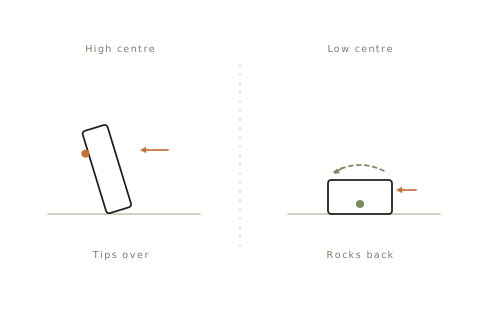
The idea, illustratedOne push, two objects. The tall light one carries its weight high and topples; the low heavy one rocks and comes back. A centre that sits low is hard to knock over.Plain-language version
Elena's dashboard
Elena runs product development for a growing company. She is good at her job, and she has, without ever deciding to, tied her sense of being okay to her dashboard. When the numbers are green she feels grounded. When a customer review is harsh or a metric dips, something inside her drops through the floor.
Elena thinks she has a resilience problem. She does not. She has a reference-point problem. She is trying to stay steady by holding on to something that never stops moving.
You cannot measure against a moving thing
Here is the physics idea, and it is a simple one. You can only tell how something is moving by comparing it to something that is not. Sailors use a lighthouse, not another boat. If your only reference is another boat, and it is rocking too, you have no way of knowing which of you is moving, and every wave feels like your fault.
Most of us anchor our inner life to other boats. Praise. Income. Likes. The mood of the person in front of us. All of them move. So our inner state moves with them, and we call that anxiety.
The fix is not to stop caring about those things. It is to stop using them as your anchor.
See the idea
Choose a reference that stays steady
01Moving reference
Your state follows the noise
Metrics, opinions and moods
Your inner state wobbles with them
02Fixed reference
Your anchor holds
Something that does not change
A steadier inner state
Metrics, opinions and moods keep moving. The chapter asks you to anchor in something that does not change with them.Read the original text diagram
MOVING REFERENCE                     FIXED REFERENCE
[ metrics / opinions / moods ]  ↔    [ something that does not change ]
         ↕ wobble                              │ steady
[ your inner state ]                 [ your inner state ]
A point that does not move
There is one in the sky, and it is the oldest one there is. Wind the universe back far enough and everything that exists, every particle and all the energy that became galaxies, planets and people, was gathered in a single point of unimaginable density. Nothing sat outside it. Nothing moved it, because there was nothing else to do any moving.
Physics stops at that point and says so plainly: the equations stop producing sensible answers there, and the word before has no clear meaning when time itself starts there. As a picture, though, it is exact. One dense, silent source, and everything that moves came out of it.
That is the kind of thing you can measure against. Not a bigger boat. The stillness the boats came from.
Two things in this book have that nature, and they have the same one. The first is what the Raja Yoga tradition calls the Supreme Soul: a point of light beyond time and decay, uncreated, untouched by anything that happens inside the cycle. The second is you, underneath. Before language, before your roles, before the expectations of everyone who has since had an opinion about you, there was a state that was dense, quiet and already complete. You did not build it and you cannot lose it. That is why the morning anchor is a return rather than a reach: you are not connecting two unlike things, you are bringing a point of light back within reach of the one it came from.
If that language speaks to you, use it: a few minutes each morning of quiet connection to something that never changes.
If it does not, the principle still holds. You need one reference that sits outside the daily weather. For many people that is a short list of what they stand for, and a few minutes at the start of the day, before any screen, to remember it. The point is not what you call the anchor. The point is that it does not move when the numbers do.
Elena did not need a thicker skin. She needed to stop asking her dashboard to tell her who she was.
Heavy things are hard to knock over
The second idea in this chapter is about weight.
Physics says that objects with a lot of mass bend the space around them. A planet does not fight the things flying past it. It simply sits there, heavy, and their paths curve around it. Smaller things move around big things, not the other way round.
Your attention works the same way. When it is scattered, you are light, and every passing storm carries you along. When it is gathered, you are heavy, and the storm has to go around you. The full edition puts it in one line:
“A mind with zero mass is entrained by every passing storm. A mind of infinite density forces the storm to entrain around it.”
In plain words: a scattered mind is dragged along by whatever is loudest. A gathered mind makes the loud things route around it.
This is what the book means by inner mass, or inner groundedness. It is not a personality type. It is the result of two things you can practise: keeping your attention gathered rather than spread, and anchoring it to a point that does not move.
Heavy is not cold
There is an objection to all of this, and it is the right one to raise. Black holes destroy whatever comes near them. If the aim is to be dense and hard to move, is the result not simply a person nobody can reach: rigid, stubborn, a little cold with everyone around them?
It is not, and the difference is in the physics. The part of a black hole that crushes is the event horizon, the boundary past which nothing returns. That is not the part this book borrows. What it borrows is the mass at the centre, which does nothing to anything. It sits there, and the paths around it bend.
The difference shows up in ordinary behaviour. A rigid person cannot take criticism, because any dent in the surface threatens the whole structure, so the defending starts before the sentence has finished. A steady person can hear all of it, including the unfair parts, because none of it reaches the centre. Weight is what lets you stay in the room, listen properly, and not need the other person to be wrong. Stubbornness is what thin people do to protect themselves.
The test is simple, and worth applying honestly. If becoming steadier is making you harder to talk to, you have built a wall rather than a centre.
Try this: the morning anchor
Before you look at any screen, sit for two minutes.
Pull your attention away from the room, the day, and yesterday. Let it settle behind your forehead.
Bring to mind your fixed point, whatever that is for you: the Source, or the two or three things you will not trade.
Say, silently, one sentence: "My baseline is anchored to something that does not move. What happens today cannot change it."
Then check your phone. Notice how differently the first message lands.
Key takeaways
Idea
In plain words
What it means for you
Reference point
The thing you measure yourself against
If it moves, you wobble. Choose one that does not.
Inner mass
Inner groundedness
Gathered attention makes you heavy enough that storms go around you.
The Source
The still, dense point everything came from, and what you are underneath
A few screen-free minutes each morning to remember what does not change.
Real-world example
A founder checks revenue before he is fully awake. If the number is up, he feels powerful. If it is down, the whole day sags before it starts. This chapter helps him separate performance from identity. He builds a two-minute morning anchor before opening any dashboard, and over time the numbers still matter, but they no longer decide whether he is inwardly steady.
What changes in you
You stop tying your peace to metrics, moods, and praise.
You create a fixed inner reference point before the outer day begins.
You become harder to knock over because your baseline stops moving with every result.
With a centre in place, friction stops being a threat. The next chapter shows how to read it as information instead.
Curious?
Questions this chapter answers
Why do I feel fine when the numbers are up and awful when they are down?
Because you are measuring yourself against something that moves. Praise, income, likes and other people's moods are other boats; anchored to them, your inner state moves with them, and you call that anxiety.
What is the fixed point the book asks me to measure against?
The stillness everything came from: one dense, silent source before there was anything to compare it to. Not a bigger boat. Two things in the book have that nature, and it is the same nature: that source, and you underneath your roles.
Mass bends the space around it. A planet does not fight what flies past; the paths curve around it. When your attention is gathered you are heavy, and the storm has to go around you.
No. The book borrows the mass at the centre of a black hole, not the event horizon that crushes. A rigid person cannot take criticism; a steady person can hear it and decide what to do with it.
Two minutes before any screen. Let your attention settle behind your forehead, bring your fixed point to mind, then check your phone and notice how differently the first message lands.
The same chapter in the original voice: the physics named in full, the Raja Yoga terms kept as taught by the Brahma Kumaris and interpreted by the author, the equations and diagrams as the author wrote them. Assembled from the manuscript drafts.
From the draft: The Inward Singularity — manuscript blueprint (Sella Yaso)
I. The Searching Observer
Consider Elena, a VP of Product Development. Elena attempts to anchor her emotional stability on her team's performance, customer reviews, and market validation. When metrics are green, she feels grounded; when metrics dip or critical feedback arrives, her internal state collapses.
Elena is trying to anchor her centre of gravity to a moving target. In a moving universe, tying your reference point to another moving body guarantees orbital instability.
II. The Mechanics: Inertial Frames and Paramdham
In Special Relativity, motion is relative to the chosen reference frame. If your frame of reference is tied to external, high-entropy variables (market shifts, social media algorithms, human moods), your internal state fluctuates continuously.
To achieve unshakeable stability, consciousness requires an Invariable Reference Point—a source that exists outside the material field and remains entirely unaffected by entropy (S = 0).
In Brahma Kumaris metaphysics, this absolute source is Shiv Baba (the Supreme Soul), located in Paramdham (the Soul World). Shiv Baba is an incorporeal Point of Light—an eternal, uncreated singularity of absolute purity, peace, and power that never enters the cycle of decay or body-conscious drag.
This is the same order of singularity that cosmology places at the origin: total density, zero extension, prior to the expansion of space and time—except that this one never expands, never cools, and never enters the cycle. Your own soul is of that nature in miniature: a point of light, uncreated, carrying its full charge before the expansion of birth scattered it outward. Phase-locking is therefore not a reach towards something foreign. It is a return of like to like.
III. Phase-Locking to the Invariable Source
By establishing an intentional connection (Yoga) to this Point of Light during early morning hours (Amrit Vela), you anchor your frame of reference to a zero-entropy source. You stop asking external environments to stabilise you; instead, you draw raw stability from the absolute centre.
IV. The 30-Second Empirical Lab Test: The Phase-Lock Calibration
Withdraw your attention from physical surroundings.
Direct the laser of your intellect (Buddhi) to the incorporeal Point of Light in Paramdham.
Visualise a beam of pure, quiet light entering the core of your mind.
Affirm: "My baseline is anchored to the Invariable Source. External movement cannot alter my internal mass."
From the draft: The Inward Singularity — manuscript blueprint (Sella Yaso)
Internal Gravity (Mass, Density & Focus)
I. The Physics of Consciousness
In Einstein's General Theory of Relativity, mass warps the fabric of spacetime, creating a gravity well:
t_0 = t_f √(1 - (2GM) / (rc^2))
Where:
t_0 = Proper Time (your internal experience of time).
t_f = Coordinate Time (the fast, frantic clock of the external world).
M = Internal Mass Density (spiritual stability, clarity, and baseline values).
r = Operational Radius (how far your attention is scattered).
Original diagram Scroll across if needed →
========================================================================
[ OBSIDIAN GRAVITY BLOCK ]

"A mind with zero mass is entrained by every passing storm.
A mind of infinite density forces the storm to entrain around it."
========================================================================
II. Increasing Mass, Collapsing Radius
When your mass (M) is low and your operational radius (r) is wide, your internal time (t_0) matches the frantic pace of external coordinate time (t_f). You feel rushed, reactive, and overwhelmed.
To reverse this:
Increase Mass (M → ∞): Root your identity in the eternal virtues of the soul.
Collapse Radius (r → 0): Pull scattered attention out of peripheral gossip, open tabs, and secondary worries back into the single point behind your forehead.
As M increases and r shrinks, your gravity well deepens. External noise begins to orbit your centre rather than displacing it.
From the draft: Chapter 1 — The Dawn of You
Understanding the Inward Singularity
Before the imposition of syntax, the weight of cultural heritage, or the suffocating architecture of social expectation, there exists a foundational state of pure primordial Originality. In the cosmology of the self, this is the Inward Singularity.
To reach this state is not an act of construction, but a profound ontological subtraction—a stripping away of every borrowed garment provided by the external world to reveal the underlying signal that has always been vibrating in the dark.
1. The Vessel vs. The Observer
To understand the Inward Singularity in human terms, we must first confront an undeniable truth of existence: human beings are not born into vacuum-sealed perfection. A newborn child may enter the world carrying genetic burdens, congenital conditions, neurodivergent traits, or physical birth trauma.
If we conflate the physical instrument with the core self, the concept of a "pure starting point" collapses under the weight of biological reality. The resolution lies in distinguishing between the vessel and the observer:
The Vessel (The Receiver): The biological hardware—the physical body, brain chemistry, genetic inheritance, and nervous system. The vessel is subject to physical entropy, genetic variability, and the immediate impact of the material world. It is the instrument through which experience is translated.
The Inward Singularity (The Signal): The unconditioned awareness inhabiting that vessel. It is the capacity to be, the silent witness behind the sensory apparatus.
A radio receiver may be born with a cracked casing, a frayed wire, or a stiff tuning dial. Yet the radio frequency being broadcast remains untainted by the condition of the receiver. The hardware determines how the signal is expressed in the physical world, but it does not define or degrade the fundamental nature of the signal itself.
2. Distinguishing Purity from Biological Perfection
In modern discourse, we frequently confuse perfection (ideal health, cognitive agility, or symmetrical form) with purity (untouched, original awareness).
Dimension
The Vessel (Physical Realm)
The Inward Singularity (Awareness)
Nature
Biological, subject to genetic variation & entropy
Pain, illness, and genetic inheritance belong to the world of form and expansion. The quiet witness within remains whole, regardless of the condition of the vessel.
3. The Nature of Potential Energy
The Inward Singularity is not "created" through the friction of effort; it is an existing foundation of 100% potential energy. While the external world demands kinetic action—a constant output of effort that leads to systemic exhaustion—the Singularity remains the silent wellspring of all future movement.
It is the most powerful state of being because it contains the entirety of your possibilities before they are thinned out by the vacuum of social reality.
"The modern seeker often collapses under the perceived necessity of 'inventing' a self. This realisation offers the profound relief of a homecoming: your Originality is an immutable signal already being broadcast. You are spared the labour of self-creation; your primary task is the arduous subtraction of the noise that obscures the source."
From the draft: Chapter 1, Section 3 — The Practice & Celebration of Internal Gravity
Spirituality, viewed through a cosmological lens, is the active maintenance and celebration of Internal Gravity. It is the intentional pull of one’s attention back towards the Inward Singularity. This discipline does not aim to halt the universe's expansion or force a complete retreat from external duties; rather, it seeks to make the individual so "dense" and grounded that external noise lacks the gravitational mass to scatter the core identity.
1. The Three Movements of Gravity
The practice of maintaining internal density is built on three distinct, deliberate movements:
Originality (The Signal): The recognition of the core identity that exists prior to expansion—the clear identification of the "I Am" before the "I Do".
Spirituality (The Shielding): The establishment of a protective layer that keeps the original signal clear, serving as a resilient boundary against external social debris.
Maintenance (The Discipline): The relentless, daily return of attention from outer expansion back to the inward source, actively resisting centrifugal fragmentation.
2. The Confluence Concept: Internal Gravity as Celebration
To ensure that maintaining gravity does not become an onerous, heavy struggle against entropy, we integrate The Confluence Perspective (inspired by the Sangam Yug or Confluence Age):
The Intersection of Two Epochs: The moment you pull your attention inward from the noise of the expanding world, you enter your personal "Confluence." You stand precisely at the junction where your reactive, fragmented self transforms into your causal, unified self.
Celebration Over Struggle: Rather than viewing discipline as a tedious battle against external noise, returning to your internal gravity is celebrated as the most fortunate moment of existence. It is a joyous realisation that while the world around you expands into complexity, you have the unique opportunity to step into the stillness of the source.
The Royalty of Self-Sovereignty: Celebrating internal gravity reframes inner return as an act of spiritual sovereignty. You are not forced to retreat; you consciously choose to sit on the "throne" of your original state, turning daily discipline into a continuous, quiet celebration of remembrance.
3. Shifting to "The Heavy Body"
By combining daily discipline with the joyful celebration of the Confluence state, you transition from a fragile object swayed by external forces into a dense, glowing celestial body. While the universe continues its noisy expansion around you, you remain anchored at your core, viewing every return to the centre not as a struggle against the world, but as a celebratory homecoming.