"The game slowed down"
Ask an experienced athlete what changed as they got better and many will say the same odd thing: the game slowed down. The ball did not move slower. The other players did not get lazier. Something in the athlete's attention changed, and a situation that used to be a blur became a set of clear, separate moments with room to choose between them.
That is the everyday version of this chapter. The physics version is stranger and, as it happens, true.
Clocks near heavy things run slow
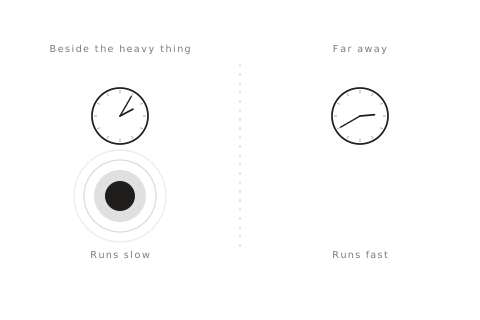
Einstein showed that a clock near a very heavy object runs slower than an identical clock far away. It is not a trick of perception. Satellites orbiting Earth have to correct for it every day. The heavier the object, the slower time passes near it. The name for this is gravitational time dilation.
The original manuscript uses it as a picture, and it is a good one. In plain words: the more inner weight you have, the slower the world seems to move around you.
When your attention is scattered, you are light, and time feels like an enemy: a rushed blur of deadlines and pings in which you react within a fraction of a second to whatever is loudest. When your attention is gathered, you are heavy, and the same events arrive with space between them.
Make room between event and response
Event → reaction
- Fast and frantic
- Little space to choose
Event → pause → response
- A more spacious moment
- Time to notice, then choose
Read the original text diagram
OUTSIDE CLOCK (scattered):   [ TICK . TICK . TICK . TICK ]   fast, frantic
INNER CLOCK  (gathered):     [ T . . . I . . . C . . . K ]   spacious, slow
The gap is where you live
Between something happening and you responding there is a gap. For most people it is very short, a few hundred milliseconds, and it is filled entirely by reflex. The insult arrives; the defence leaves. The email lands; the reply is half-written before you have finished reading.
Every practice in this book, the pull-back, the anchor, the three-step reset, does one thing at the physical level: it widens that gap. And the gap is where every good decision you have ever made was born. Widen it, and a crisis stops being one blurred event and becomes a sequence of moments, each with room for a choice.
This is what the athlete means. Nothing outside slowed down. The gap inside got wider.
| Same event | Narrow gap (scattered) | Wide gap (gathered) |
|---|---|---|
| A sharp question in a meeting | Defensive answer before the question is finished | A breath. "Good question. Here is what I know." |
| A system goes down | Ten messages sent in two minutes, three of them wrong | Thirty seconds to see the shape of it, then one clear instruction |
| Bad news at home | The first thing that comes out is the thing you regret | Silence long enough to choose the first sentence |
Try this: the gap drill
For one day, every time you feel the urge to respond to anything, count silently to three before you do. Emails, questions, comments, notifications. Three seconds. It will feel like an eternity and look, from outside, like nothing at all.
At the end of the day notice two things: how often the three seconds changed what you said, and how much slower the day felt. That second thing is time dilation, and you did it with a count of three.
Key takeaways
| Idea | In plain words | What it means for you |
|---|---|---|
| Time dilation | Steadier inside means slower-feeling time outside | The heavier you are, the more room each moment has. |
| The gap | The space between what happens and what you do | Every practice in this book widens it. Every good decision lives in it. |
| The count of three | A deliberate pause before any response | The smallest possible version of the whole chapter. |
Real-world example
A doctor, driver, or operator in a high-pressure situation often says that the best moments feel strangely slow. This chapter explains why. When inner noise drops, the space between event and response widens. Instead of rushing because the clock feels fast, the reader learns to widen perception, act cleanly, and feel more time inside the same minute.
What changes in you
- You begin to feel more space between stimulus and response.
- You panic less because urgency no longer owns the whole field of awareness.
- You perform better under pressure because your mind has more room to move.
The toolkit is complete. Part III is about living with it, starting with a choice about what kind of life you are trying to build.