The point of no return
Every worthwhile thing has a threshold. The moment you send the proposal. The moment you say the difficult sentence. The moment you commit the money, or the year, or your name. Before the threshold, you can still turn back. After it, you are in.
Astronomers have a term for the edge of a black hole beyond which nothing turns back: the event horizon. The original borrows it for the seventh power, the power to face, and calls it event horizon courage. In plain words: the ability to step across the line into a situation whose outcome you cannot see, without freezing at the edge.
Most people do not lack courage. They lack the composure to be afraid and still step. The difference is inner weight. A thin, scattered person at the threshold is all fear and no ballast. A gathered person is still afraid, but the fear has somewhere to sit that is not the driver's seat.
Where the fuel comes from
The eight powers are tools, and tools need fuel. The original draws the fuel from what the Raja Yoga tradition calls the seven virtues of the soul, received through connection to the Source. You do not need the theology to use the list. In plain words, these are the seven inner states that make the powers possible.
| Virtue | In plain words | What it fuels |
|---|---|---|
| Purity | Clean intentions, no hidden agenda | Signal you can trust, from yourself |
| Peace | A baseline of stillness | Recovery speed. Somewhere to return to. |
| Love | Connection that asks nothing back | Team harmony without keeping score |
| Happiness | Contentment that does not depend on the outcome | Low friction. Work that does not grind. |
| Bliss | A deep, quiet fullness | Immunity to bribes, flattery, and fear of loss |
| Power | The capacity to act without forcing | Execution. Turning a decision into movement. |
| Knowledge | Seeing the situation clearly, whole, and in context | Composure. You are not surprised by the surface. |
One way to read the table: when a power fails you, look at the row that feeds it. If you cannot face the threshold, it is usually peace or knowledge that has run low, not courage.
Setting the tempo of the room
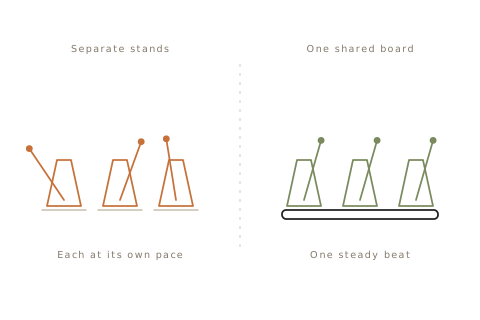
In 1665 a Dutch scientist noticed that two pendulum clocks hung on the same wall would, within an hour, swing in perfect step. They were nudging each other through the wood. The tendency of nearby rhythms to fall into line is called entrainment, and the original uses it for the eighth power, the power to cooperate: harmonic resonance.
In plain words: the steadiest rhythm in a room sets the tempo. Walk into a panicking meeting and you can either catch the panic or become the clock the others fall into step with. Which one happens depends almost entirely on which of you is heavier.
This is what the book means by cooperation. Not compromise, not agreeableness, and certainly not winning. It is being so settled that other people settle near you, and then working from that shared calm. Teams built this way do not need much ego management, because nobody is fighting for the tempo.
The pace you bring into the room
Tension feeds tension
- You catch the room’s urgency
- Your reaction adds to it
A steadier rhythm
- You keep your own centre
- You offer the room a calmer pace
Read the original text diagram
scattered person enters a tense room  →  catches the tension, adds to it
gathered person enters a tense room   →  the room slows to their pace
Try this: before the hard meeting
- Two minutes before, sit and pull your attention back to centre. One slow breath for each of the seven virtues, naming it silently.
- Say one sentence: "I am here to add clarity. I need nothing from this room."
- Walk in and speak more slowly than feels natural. Watch what the room does over the next five minutes.
Key takeaways
| Idea | In plain words | What it means for you |
|---|---|---|
| Facing | Stepping across the line while still afraid | Composure is fear with ballast. |
| The seven virtues | Seven inner states that fuel the powers | When a power fails, feed the virtue underneath it. |
| Resonance | The steadiest rhythm sets the room's tempo | Be the clock the others fall into step with. |
Real-world example
A family business hits a stressful week: a supplier problem, a tense staff member, and a major customer call. One person in the room either amplifies the chaos or settles it. This chapter shows how courage and cooperation belong together. The leader enters the difficult conversation without bravado, speaks clearly, and keeps ego out of the room. The atmosphere changes because one steady rhythm starts to lead the others.
What changes in you
- You become more willing to step into pressure without theatrics.
- You reduce ego friction in rooms that need clarity more than self-protection.
- You discover that steadiness spreads socially, not just privately.
One more tool completes the kit, and it is the one people find hardest to believe: you can change how fast time feels.