Why it has to be daily
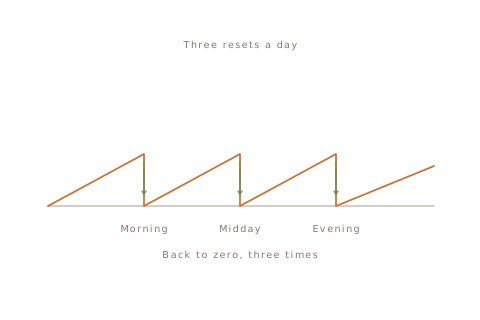
Everything in the first nine chapters can be understood in an afternoon and lost by the following Tuesday. Steadiness is not a fact you learn. It is a level you maintain, and the world spends every day lowering it.
So the book gives you a routine. It has three parts, it takes less than an hour in total, and it is built around the three points in the day when your attention is most likely to be pulled away: the first minutes, the busy middle, and the last hour.
| Phase | When | How long | The job |
|---|---|---|---|
| 1. The morning anchor | On waking, before any screen | 15 to 30 minutes | Set your centre and choose one direction before the world gets a vote. |
| 2. Midday pauses | Top of the hour, or at 11, 2 and 5 | 60 seconds each | Drop accumulated tension and reset the gap. |
| 3. The evening shutdown | The last 30 minutes before sleep | 30 minutes | Close open loops, put down every role, and go to bed empty. |
Phase one: the morning anchor
In the Raja Yoga tradition the early morning hour is called Amrit Vela and is set aside for quiet connection to the Source. The book keeps that name and that purpose. In plain words: the first minutes of the day belong to you, not to your phone.
- No input. No screens, no news, no messages. This is the single most important rule in the chapter.
- Put down yesterday. Titles, unfinished arguments, and old worries do not come through the door with you. Sit for a few minutes as the watcher from Chapter 9.
- Connect to your fixed point, from Chapter 2, in whatever form that takes for you.
- Write one line: the single thing that, if it moved today, would make the day a success.
Then, and only then, open the phone. You will find the first message lands on a person who has already decided what today is for.
Phase two: midday pauses
Tension accumulates through a working day whether or not anything goes wrong. The book's answer is a sixty-second pause at fixed times. The original calls these micro-retractions: the tortoise from Chapter 1, briefly.
- Stop. Step back into the watcher.
- Scan for drag: tension in the body, a reply being composed in your head, something you are over-explaining to yourself.
- Drop it. One deep breath. Return to the one line you wrote this morning.
Two more practices belong to the working day. Do your most important work in blocks of about ninety minutes with everything else closed. And handle messages in two fixed windows, say late morning and late afternoon, rather than continuously. Checking messages all day subjects you to a small shock every few minutes, and each one costs recovery time.
Phase three: the evening shutdown
The last half hour before sleep is where you close the day's account. The original calls this packing up, the second of the eight powers, applied to the whole day.
- Review the day without emotion. Where did energy leak? Treat it as data, not as a verdict on yourself.
- Write down every open loop. Not finished, just written, so the mind can put it down.
- Put down every role. For the night you are not a manager, a parent, a founder, or a name. You are the watcher, going to rest.
Your personal dashboard
The book asks you to track four things. Not hours worked or tasks completed: four measures of inner steadiness, in plain language. A quick score out of five for each at the evening shutdown is enough.
| Measure | The question | Good looks like |
|---|---|---|
| Signal ratio | How much of today was the real thing, and how much was answering pings and putting out fires? | Most of the day on your one line |
| Recovery speed | After the worst interruption today, how long until I was calm again? | Under sixty seconds |
| Chosen vs reactive | What share of my energy went to my own priorities, rather than other people's emergencies? | Around four fifths chosen |
| Composure | How steady did my mood stay when the room, or the news, was not? | Unchanged by the weather |
The weekly check
Once a week, score these five questions from 1 (rarely) to 4 (almost always).
- Do I pause before reacting to an unexpected message or crisis?
- Do I spend little energy defending my status or my opinions?
- Do I disconnect cleanly at the evening shutdown?
- Do I keep an unhurried pace inside when the environment is frantic?
- Did I do the morning anchor most days this week?
| Score | Where you are | What to do |
|---|---|---|
| 5 to 9 | Scattered. Attention is mostly outside. | Rebuild the morning anchor first. Nothing else works without it. |
| 10 to 14 | Steady foundation, wobbles under pressure. | Add the midday pauses. That is where the wobble lives. |
| 15 to 20 | Anchored. The Prime Mover state is active most days. | Protect the routine. Deepen, do not add. |
Key takeaways
| Idea | In plain words | What it means for you |
|---|---|---|
| The three phases | Morning anchor, midday pauses, evening shutdown | Under an hour a day, placed where attention is most at risk. |
| No input first | The first minutes belong to you | Decide what the day is for before the phone gets a vote. |
| The dashboard | Four plain measures of steadiness | Signal, recovery, chosen vs reactive, composure. Score them nightly. |
| Batching | Messages in two windows, deep work in ninety-minute blocks | Constant checking is constant small shocks. |
Real-world example
A reader loves the ideas of the book but keeps losing them by Thursday. This chapter solves that problem by turning philosophy into rhythm: morning grounding, midday resets, and an evening shutdown. Within a week the day has edges again. The reader is no longer waiting for crisis to remember the practice, because the practice now arrives before the crisis does.
What changes in you
- You gain a repeatable daily structure for protecting inner steadiness.
- You begin calibrating yourself before drift becomes damage.
- You turn insight into routine so that the book lives in your day, not just in your head.
The last chapter is about what happens when the routine stops being a routine and becomes who you are.