The physics of the Prime Mover
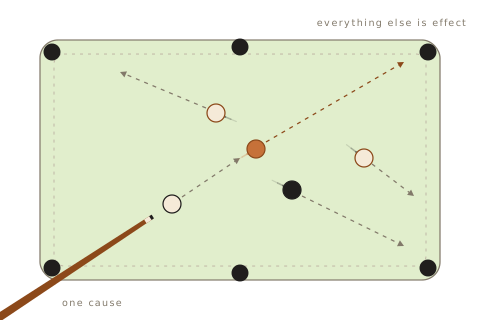
On a pool table, every ball is in motion after the break. Balls strike cushions, collide, roll into pockets. All of them are moving. But only one thing on the table caused the motion: the cue. Everything else is effect.
The phrase Prime Mover is old. Aristotle used it for the first cause that sets everything else in motion without itself being moved. The Inward Singularity borrows it for a person. Most of us live as balls: struck by a message, we roll into a reply; struck by someone's urgency, we roll into their emergency. By evening we have travelled a long way, and none of it was our direction. A Prime Mover is the one who sets a direction first, and meets the collisions from there.
It is the book's subtitle, its destination, and the last of the five stages on its path: entropy, discrimination, gravity, density, Prime Mover.
Motion is not causation
The distinction the term rests on is between being busy and being the cause of something.
EFFECT (the ball)                          CAUSE (the cue)
struck by a message ──► rolls into reply   sets one direction first
struck by urgency   ──► rolls into crisis  meets collisions from centre
ninety messages answered, nothing moved    one line moved; the rest queued
Reaction is not lazy, which is what makes it such a good disguise. Answering ninety messages is effortful, feels productive, and earns thanks. But effort spent as the effect of other people's causes does not accumulate into anything; tomorrow there are ninety more. Causation compounds. Three hours on the thing that matters in a year are still there next month, and become the foundation the next three stand on.
The book gives this a measure: the share of your energy that went to things you chose, against the share that went to things that chose you. The target is roughly four fifths chosen. Most people, measuring honestly for the first time, find they are nearer one fifth.
What a Prime Mover is not
Not someone who never gets struck. Things happen to a Prime Mover all day. Not someone who controls outcomes; outcome weight is one of the five kinds the book asks you to drop. And not force. In the manuscript's language, force is the weapon of the weak and mass the instrument of the sovereign. A Prime Mover does not push harder than the room. They become heavy enough that the room begins to arrange itself around them.
The three laws
The book distils the stance into three laws, set out in Chapter 11.
- Inner causality. Nothing outside you has power over your inner state unless you hand it over. The moment you catch yourself blaming a person or an event for how you feel, take the weight back.
- Zero friction. Meet opposition with stillness and clear intent, not with more noise. Return to baseline first; act second.
- Continuous release. Holding on to the past is the end of original action. Every morning is a clean slate; yesterday's wins and wounds stay in yesterday.
Becoming one: the daily version
The Prime Mover is not a personality you either have or lack. It is what the daily routine produces when it is kept.
- The morning anchor. Before any screen, write one line: the single thing that, if it moved today, would make the day a success. That line is the cue; everything else on the table is a ball.
- Midday pauses. Sixty seconds on the hour to drop tension and return to the line, so a day of collisions does not quietly become a day of reaction.
- The evening shutdown. Score the day, write down the open loops, put down every role. Nothing carried forward, so tomorrow can be caused rather than continued.
At the end of the day the only score is whether the line moved.
The Prime Mover stance
Still at the centre, fully active in the world. Not retreat, and not detachment in the cold sense, but presence with weight underneath it. When a family is frightened, a team is mid-failure, or the news is bad and everyone is talking at once, most people are carried by the surface. The Prime Mover is the fixed point the others measure against, the clock they fall into step with. They do not have to say anything about it. It is simply true of the room while they are in it.
Related terms: Inner Mass, Recovery Speed, Ontological Subtraction, Cosmic Debris. Taught in Chapter 1 and Chapter 11: Uninterrupted Sovereignty. See also the eight powers and the essay The Difference Between Motion and Causation.