The physics of discrimination
An old radio, slightly off the station, gives you a voice buried in hiss. Turn the dial a little and the hiss drops away. The voice was there the whole time. What changed was the ratio of signal to noise.
Engineers use exactly that phrase, signal-to-noise ratio, for any channel where the real message competes with static. It is one short relationship: the strength of the signal divided by the strength of the noise. There are two ways to improve it. You can make the signal louder, or you can make the noise quieter.
Most people try the first. They work harder, read faster, reply sooner, and hope the important things will rise above the rest. The Inward Singularity takes the second route. You do not need to hear the signal more loudly. You need to stop listening to the hiss.
Not the modern meaning
The word needs a moment of care. Discrimination here has nothing to do with treating people unfairly. It is the older meaning: the ability to tell things apart. Signal from noise. What matters from what is merely loud.
In the Raja Yoga tradition the book draws on, this is Parakh Shakti, the fifth of the eight powers. The word carries the sense of appraisal, the way a jeweller tests whether gold is real. It is described as a faculty of the intellect (buddhi): the same faculty that recognises the soul behind a body, or the truth behind a claim. Applied to an ordinary working day, it becomes something very practical, a gate on what is allowed to take your attention.
About five percent
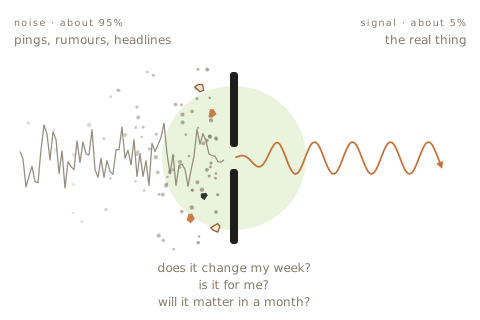
The original manuscript makes a blunt estimate: in a modern working day, about five percent of what reaches you is the real thing. The other ninety-five is hiss.
INCOMING (the day)               THE GATE                      PASSES
pings, rumours, headlines  ──►  does it change my week?   ──►  the real thing
other people's urgency          is it for me?                  (about 5%)
the vague sense of "more"       will it matter in a month?
Treat the number as the book intends, as an estimate rather than a measurement. Its point is not to complain about the world. It is a reason to spend serious effort on the dial, and very little on the static.
The second stage
The Inward Singularity describes a five-stage path from scattered to steady:
- Entropy. Many arrows; attention pulled in every direction.
- Discrimination. Fewer signals; noise filtered out.
- Gravity. Attention begins returning to the centre and staying there.
- Density. Less noise, more depth.
- Prime Mover. Intentional action; the cause of your day, not its effect.
The order matters. You cannot gather your attention while you are still letting everything in. Entropy is the drift towards scatter; discrimination is the first thing that pushes back, by reducing the number of pulls that ever reach the centre.
The three questions
Run any incoming demand through three questions. Together they act as the dial.
- Does this change what I will do in the next week? If not, it is noise, however emotional it feels.
- Is this addressed to me, or just arriving near me? A great deal of outrage is simply weather passing through your feed.
- Would I still care about this in a month? A surprising amount of urgency has a shelf life of one afternoon.
| Arrives as | Usually is | Do |
|---|---|---|
| A headline you feel you must have a view on | Noise | Let it pass. You are not required to have an opinion. |
| A colleague's panic about their deadline | Noise for you, signal for them | Be kind. Do not pick it up. |
| A clear request tied to your one priority | Signal | Act, and act once. |
| A vague sense you should be doing more | Noise dressed as conscience | Return to the priority you already chose. |
What discrimination is not
It is not ignoring people. The second row of that table is the important one. Something can be noise for you and real for someone else. Discrimination decides what you carry, not whether you are kind.
It is not cynicism. Rejecting everything is as undiscriminating as accepting everything. Both skip the actual work, which is looking at each thing long enough to tell what it is.
It is not the same as subtraction. Ontological subtraction puts down weight you are already carrying: roles, opinions, commitments. Discrimination works at the door, on what is arriving now. One clears the room; the other keeps it clear. What slips past the gate unexamined tends to end up as cosmic debris.
Working the dial: three practices
1. The one-line day
Tomorrow morning, before any screen, write one line: the single thing that, if it moved forward today, would make the day a success. Put it where you can see it. It gives the three questions something to measure against. Anything that is not that line can queue.
2. Name it before you answer it
When something grabs your attention, silently label it before you act: signal, or noise. The label takes less than a second. It is enough to break the reflex of answering whatever is loudest, and over a week it trains the gate to work on its own.
3. Let one headline pass each day
Choose one thing a day that you would normally feel obliged to have a view on, and deliberately decline to form one. Notice that nothing happens. That small, repeated proof is what loosens the belief that everything arriving deserves a response.
After the gate: judgement
Discrimination is the first half of what the book calls the Decision Pair. Once the signal is isolated, the sixth power, judgement, takes over: decide once, commit fully, and do not carry the decision around as an open question. A clear signal with a divided decision still goes nowhere. Filtering and deciding are taught together for that reason.
The Prime Mover stance
A Prime Mover does not hear less than anyone else. The pings still arrive, the headlines still shout, the room still hurries. What has changed is that most of it no longer gets through to the centre. The hiss is still there. It has simply stopped setting the agenda.
Related terms: Entropy, Density, Ontological Subtraction, Prime Mover. Taught in Chapter 6: Filtering Noise and One-Direction Focus. See also the power of discrimination among the eight powers.