The physics of entropy
Leave a hot cup of tea on a desk and it cools to the temperature of the room. Leave the room and it never warms back up on its own. Drop a spoonful of milk into the tea and it spreads; it never gathers itself back into a spoonful. The second law of thermodynamics describes this one-way tendency: left to itself, energy spreads out, and order gives way to disorder. Entropy is the name for how spread out, how disordered, a system has become.
There is a quieter way to say the same thing, and it is the one that matters for a mind. There are vastly more ways for things to be scattered than for them to be arranged. A desk can be tidy in only a few ways and untidy in millions, which is why desks drift towards untidy and never the other way round. Nothing is pushing them there. Disorder is simply the likeliest outcome.
Your attention works the same way. There are a few ways to spend a morning on the one thing that matters, and endless ways to spend it on messages, tabs, worries and other people's urgencies. With no deliberate effort, a day drifts to the second kind. Not because you are weak, but because scatter is the default.
The high-entropy world
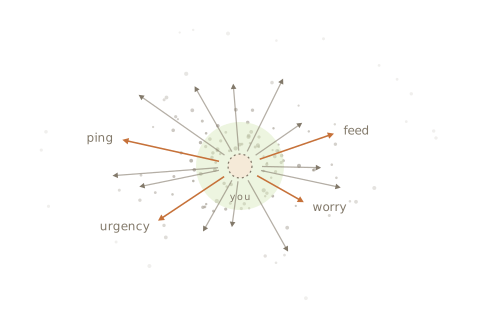
The book's subtitle is Become the Prime Mover in a High-Entropy Universe. The phrase describes the environment most of us now live in: one that does not merely allow attention to drift, but pulls it apart on purpose.
EXTERNAL ENTROPY (the high-noise field)
   │         │         │         │
   ▼         ▼         ▼         ▼
 ping      feed      worry     urgency
   └─────────┴────┬────┴─────────┘
                  ▼
     attention stretched across many vectors
                  ▼
     effort cancels out: tired, and nothing moved
Every notification, feed and demand is a small pull in its own direction. Each is harmless. Together they produce what the book calls pulling in every direction at once: effort split across so many vectors that it cancels itself out. This is why you can be exhausted at the end of a day in which nothing important moved. The tiredness is real. It is the heat of an engine spinning its wheels.
What entropy is not
It is not a character flaw. The first chapter of the book exists to make this point. Scatter is what happens to any system that is not actively maintained. Treating it as a moral failure only adds guilt to the drag.
It is not the same as cosmic debris. Cosmic debris is the residue you carry: the replayed email, the staged argument, the open loops. Entropy is the tendency that produces it. Debris is what entropy leaves in your orbit.
It is not solved once. This is the most important part. A tidy desk does not stay tidy. A gathered mind does not stay gathered. In physics, order can only be kept by putting energy in continuously. That is not a failure of the method; it is the reason the method is daily.
From entropy to steadiness
Entropy is stage one on the path the book describes:
- Entropy. Many arrows; scattered attention.
- Discrimination. Fewer signals; noise filtered out.
- Gravity. Attention begins returning to the centre.
- Density. Less noise, more depth.
- Prime Mover. Intentional action; the cause of your day.
Each later stage is a way of working against the drift. Discrimination reduces the number of pulls you let in. Gravity brings attention back when it wanders. Density keeps it concentrated. None of them abolish entropy. They keep you, deliberately and daily, on the ordered side of it.
Working against the drift: three practices
1. Lower the noise coming in
Most of what arrives is static. Run each incoming demand through three questions: does this change what I will do in the next week; is it addressed to me or just arriving near me; would I still care about it in a month? If not, let it pass. Every pull you decline is one fewer arrow.
2. Put energy in on purpose
Order needs a steady input. That is what the daily routine is: fifteen screen-free minutes on waking to set one direction before the world gets a vote; sixty-second pauses on the hour to gather attention again; an evening shutdown to close the loops before sleep. Small, regular inputs keep a system ordered far better than occasional heroic ones.
3. Signal over static
The original manuscript calls the goal zero entropy, and translates it as signal over static: the most meaningful action with the least wasted motion. In practice it means cutting over-explaining, defensive loops and busywork, which are all energy spent and none of it moving anything.
The Prime Mover stance
A Prime Mover does not expect the world to become quiet. The universe stays high-entropy; the feeds keep pulling; the desk keeps drifting. What changes is that someone is now putting energy in, on purpose, every day, from the centre. Scatter remains the default. It stops being your default.
Related terms: Cosmic Debris, Density, Inner Mass, Prime Mover. Taught in Chapter 1: Why You Feel Scattered and Chapter 6: Filtering Noise and One-Direction Focus. See also the essay The Attention Economy Wants You to Have No Centre.