The physics of inner mass
In physics, mass is not size. A small object can be very heavy, and a large one very light. What mass measures is how much is actually there, and how hard it is to move. Objects with a great deal of mass bend the space around them: a planet does not fight the things that fly past it, it simply sits there, heavy, and their paths curve around it. Smaller bodies move around larger ones, never the other way round.
The Inward Singularity uses this as its central picture of the mind. Your attention is a fixed quantity. Spread across forty pulls, it is thin at every one of them, and thin things are light and easily moved. Gathered at one centre, the same attention is dense, and dense things are hard to shift.
This is inner mass. It is not a personality type and not a mood. It is the result of two things you can practise: keeping your attention gathered rather than scattered, and anchoring it to a fixed point that does not move when the numbers do.
Why low mass makes small things hurt
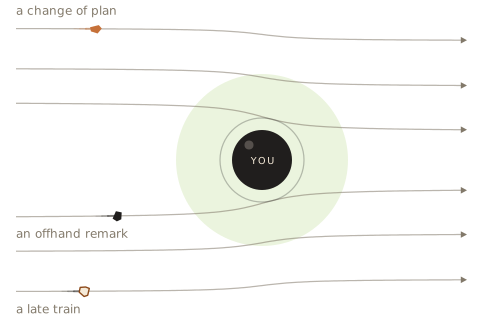
A scattered person is not too sensitive. They are too thin, the state the book calls spaghettification. A change of plan, an offhand remark, a late train: none of these should be catastrophes, but when nothing dense is at the centre to receive them, they tear straight through.
LOW MASS  (scattered)                 HIGH MASS (gathered)
attention out on every pull    ──►    attention at one centre
light, moved by every storm    ──►    heavy; the storm goes around
small knocks go straight in    ──►    small knocks bounce off
In the original manuscript the line is: "A mind with zero mass is entrained by every passing storm. A mind of infinite density forces the storm to entrain around it." In plain words: a scattered mind is dragged along by whatever is loudest; a gathered mind makes the loud things route around it.
Inner mass is also what the other powers draw on. The power to tolerate criticism, for instance, is not gritting the teeth; it is having enough of you present that the heat of a remark spreads through a large body and dissipates. The same shock that boils a teaspoon barely warms a full pot.
Building mass: three practices
1. Gather (the pull-back)
Thirty seconds, eyes closed. Put every task down, not solved, just down. Imagine every stray thread of attention being drawn back to the centre of your chest. This is the smallest unit of inner mass, and it is available at any moment, including mid-meeting.
2. Anchor (the fixed point)
You cannot measure against a moving thing. Sailors use a lighthouse, not another boat. If your sense of being all right is tied to metrics, moods and praise, your inner state moves with them. Choose one reference that sits outside the daily weather, and spend a few screen-free minutes each morning returning to it. In the author's tradition that fixed point is the Supreme Soul; the principle holds whatever you call it.
3. Protect (depth over breadth)
Mass is lost by spreading. Every commitment kept out of guilt, every opinion defended in every room, every goal that was never yours thins the field. Density rises when the same you covers less ground. This is why saying no, in the book's language, creates mass.
The Prime Mover stance
A Prime Mover does not try to become unshakeable by force of will. They become heavy, and let physics do the rest. The world does not stop pushing; it stops being able to move you. Friction drops, recovery quickens, and the room begins, quietly, to arrange itself around the steadiest person in it.
Related terms: Density, which asks how thinly that mass is spread; Cosmic Debris, Recovery Speed, Ontological Subtraction. Taught in Chapter 2: The Unshakeable Centre and Chapter 5.