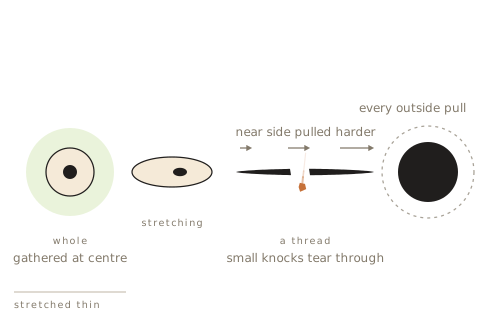
The physics of spaghettification
Near a black hole, gravity does something stranger than pull. It pulls unevenly. The side of an object closest to the black hole feels a much stronger pull than the side furthest away, and over a short distance that difference becomes enormous. The object is stretched along its length and squeezed across its width, until it is drawn out into a long thin thread.
Astronomers, with a straight face, call this spaghettification. The official name for the uneven pull is a tidal force, and it is the same effect, in a far gentler form, that the Moon has on Earth's oceans.
You do not need the astronomy. You need the picture: something whole, pulled from many directions and at different strengths, until it is thin.
What it looks like in a day
The Inward Singularity uses spaghettification for what happens to your sense of self when you live entirely on the outside of it. Your energy is poured into screens, expectations and other people's urgencies. Each of them pulls. Some pull harder than others. None of them pull you towards your own centre.
The deep version of Chapter 1 describes three signs:
- Your focus is stretched thin across too many places to be fully present in any one of them.
- Your emotional stability depends on things you cannot control: the reply that has not come, the number that dipped, the mood of the person in front of you.
- Your sense of who you are loses its centre, and scatters into whatever is happening around you.
WHOLE (gathered)                    STRETCHED THIN
attention at one centre      ──►    attention across every pull
knocks land on something     ──►    knocks go straight through
"a comment"                  ──►    "a personal attack"
Why small things start to hurt
This is the most practical part of the term, because it explains a feeling most people misread.
A change of plan, an offhand remark from a colleague, a late train: none of these should be catastrophes. But when you are stretched thin, they tear straight through. There is not enough of you at any one point to receive them.
The usual conclusion is "I am too sensitive", or "I need a thicker skin". The book offers a different reading, and a kinder one. You are not too sensitive. You are too thin. The fragility is not a feature of your character. It is a feature of the shape you have been pulled into, and shapes can change.
What reverses it
Spaghettification is the opposite of inner mass. Where inner mass is attention gathered at one centre, spaghettification is the same attention pulled out along every line of demand. The remedies are the practices that gather it again.
- Come back to centre. The book's answer in Chapter 1 is the tortoise, which draws its limbs into its shell when trouble arrives. This is the first of the eight powers, the power to withdraw, and the daily practice of gravity: each time attention is noticed out on a thread, it is brought home.
- Cut the number of pulls. Every outside demand you let in is one more line of tension. Discrimination lets most of them pass before they take hold.
- Cover less ground. A thread is what a fixed amount of material becomes when it is spread over too much length. Density is the same material over less, which is why saying no is not a loss but a thickening.
The thirty-second test
You do not have to take the idea on trust.
Before you start, notice your body: the tension in your jaw, the speed of your breathing, the background hum of things waiting for you. Close your eyes. For thirty seconds, put down every task. Not solved, just put down. Imagine each stretched thread of attention being drawn back to the centre of your chest. Then open your eyes and notice whether your breathing slowed and your shoulders dropped.
Nothing on your list changed. The shape of your attention did.
A second use: letting the old self stretch away
The deep version of Chapter 3 uses the same word in a very different way, and it is worth knowing so the two are not confused.
There, spaghettification describes something chosen rather than suffered. In a section on rebirth, the old identity is allowed to come apart the way matter does as it crosses an event horizon: past titles, old grievances and the need to be right about past conflicts are let go, cleanly and without defence. What remains afterwards is not a thinner self but a denser one, free of what it had been carrying.
The two uses fit together. In the first, the outside world stretches you, and what gets thin is you. In the second, you let go, and what gets thin is only the debris you were carrying around yourself.
The Prime Mover stance
A Prime Mover still lives in a world full of pulls. The difference is that none of them is allowed to become the shape of the self. Attention goes out to the task, the conversation, the message, and then it comes home. A self kept whole in this way can take a knock, because there is always enough of it in one place to receive one.
Related terms: Inner Mass, Entropy, Density, Gravity, Cosmic Debris. Taught in Chapter 1: Why You Feel Scattered, with the second use in the deep version of Chapter 3: Resistance Is Just Data.