The physics of gravity
Stars are not built. They are gathered. A star begins as a thin cloud of gas and dust spread across a vast stretch of space, and gravity does the rest: every particle pulls gently on every other, and over time the scattered cloud falls inward towards a centre until it is dense enough to shine.
Two things about gravity matter for this book. First, it is patient. It is by far the weakest of the fundamental forces, yet it never switches off, and so over time it shapes galaxies. Second, it always points the same way: inward, towards the centre of mass. Whatever has drifted out is, sooner or later, drawn back.
The Inward Singularity borrows gravity as its picture for what happens to attention when you practise. Not a heroic effort to stop the mind moving, but a steady pull that keeps bringing it home.
Gravity is the return, not the absence of wandering
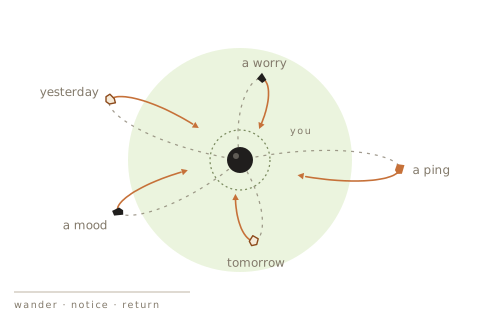
This is the most useful thing to understand about the term, and the most freeing. Your attention will wander. It will leave for a message, a worry, a replayed conversation, a plan for tomorrow. That drift is entropy, and it is the default for every mind, not a sign that you are doing it wrong.
Gravity is what happens next.
WANDER    attention leaves: a ping, a worry, yesterday
NOTICE    you see that it has gone
RETURN    you bring it back to centre, without scolding
          ── and again, all day ──
Anyone who has sat to meditate knows the pattern. The mind wanders within seconds. The practice is not the stillness between wanderings; the practice is each return. A day with a hundred wanderings and a hundred returns is a day of strong gravity. A day with one long wandering and no return is a day without it.
How gravity differs from inner mass
The two terms are close, and they help each other.
Inner mass is how much of you is gathered at the centre. Gravity is the pull that does the gathering. Mass is the state; gravity is the movement that produces it.
They reinforce each other the way they do in space. The more mass gathers at a centre, the stronger its pull; the stronger the pull, the more gathers. Each small return adds a little weight, and a little weight makes the next return easier. This is why the practices feel hardest in the first week and quieter after a month. Density then asks the last question: how thinly is that gathered self being spread?
The tortoise and the lighthouse
The book uses two pictures for gravity, and a return needs both.
The tortoise is the pull. When a tortoise senses trouble it does not argue with the trouble or try to rearrange the field around it. It draws its limbs into its shell. This is the first of the eight powers, the power to withdraw (Sametne ki Shakti), which the original manuscript calls gravitational retraction: bringing attention back to your own centre without leaving the room. When things settle, the tortoise comes out again, by choice.
The lighthouse is where the pull lands. You can only steady yourself against something that does not move. Sailors take their bearings from a lighthouse, not from another boat. In the author's Raja Yoga tradition that fixed point is the Supreme Soul, a point of light beyond time and decay; for readers outside the tradition it can be the two or three things you will not trade. Either way, pulling attention back is only half the job. It needs somewhere steady to land.
The third stage
The Inward Singularity describes a five-stage path from scattered to steady:
- Entropy. Many arrows; attention pulled in every direction.
- Discrimination. Fewer signals; noise filtered out.
- Gravity. Attention begins returning to the centre and staying there.
- Density. Less noise, more depth.
- Prime Mover. Intentional action; the cause of your day, not its effect.
Gravity comes after discrimination for a practical reason. While everything is let in, returning to centre is like bailing out a boat with the tap still running. Once most of the noise has been recognised and allowed to pass, each return starts to hold.
The three movements
The deep version of the book describes the practice of internal gravity as three deliberate movements.
- Originality, the signal. Recognising the core identity that exists before any role: "I am" before "I do".
- Spirituality, the shielding. The protective layer that keeps your original signal—the unconditioned, silent witness behind sensory experience—clear of social debris. It acts as a resilient boundary against external entropy and peripheral noise.
- Maintenance, the discipline. The daily return of attention from the outside world to the inward source, again and again.
The manuscript adds an important note on tone. Returning to centre is not meant to feel like a grim struggle against the world. Drawing on the Raja Yoga idea of the Confluence Age (Sangam Yug), it describes each return as a small celebration: a moment of stepping out of a noisy, expanding world into the stillness of the source. A discipline experienced as homecoming lasts far longer than one experienced as a fight.
Practising gravity: three returns
1. The thirty-second pull-back
Close your eyes. Put every task down, not solved, just down. Imagine every stray thread of attention being drawn back to the centre of your chest, the way a star pulls scattered gas into its core. Open your eyes and notice how much more spacious the next thirty seconds feel. This is gravity in its smallest unit.
2. The morning anchor
Before any screen, sit for two minutes. Let your attention settle behind your eyes, and bring your fixed point to mind. Then open the phone, and notice how differently the first message lands. The day's returns are easier when the centre was found before the day began.
3. The hourly return
The book's daily routine, which the manuscript calls the Daily Gravity Protocol, builds gravity into the working day: sixty seconds on the hour to drop tension and come back to the one line you wrote that morning. No single return is dramatic. Twelve of them change the shape of a day.
What gravity is not
It is not withdrawal from life. The tortoise comes out again. The aim is not to stop the world expanding or to retreat from duties, but to be gathered enough that the world's noise cannot scatter you.
It is not force. Gravity does not strain. A return made with a scolding voice adds friction; a return made gently simply returns.
It is not done once. A star keeps its shape because gravity never stops acting. A centre is kept the same way.
The Prime Mover stance
A Prime Mover's attention wanders like anyone else's. The difference is that it always comes home, quickly and without drama, and so the centre is always occupied when something important arrives. Over months, that constant quiet return becomes a kind of weight other people can feel. They find themselves orbiting the steadiest person in the room, without either of them quite knowing why.
Related terms: Inner Mass, Entropy, Discrimination, Density, Prime Mover. Taught in Chapter 1: Why You Feel Scattered, Chapter 2: The Unshakeable Centre and Chapter 10: The Daily Routine. See also the power to withdraw and the essay Your Calendar Reveals Your Physics.