The physics of an event horizon
A black hole's event horizon is not a wall. There is nothing there to touch, no surface, no shell. It is simply the distance at which the pull becomes so strong that leaving would require travelling faster than light, which nothing can do. Inside that distance, every possible path leads inward.
Two things make it a useful picture. First, crossing it is undramatic. An object falling in notices no bump, no barrier, no moment of impact. Second, it is absolute. After the crossing there is no version of the story in which you turn round and come back out. The distance at which this happens is named after Karl Schwarzschild, who worked it out within months of Einstein publishing his theory.
Undramatic, and irreversible. That combination is exactly what The Inward Singularity borrows.
The point of no return
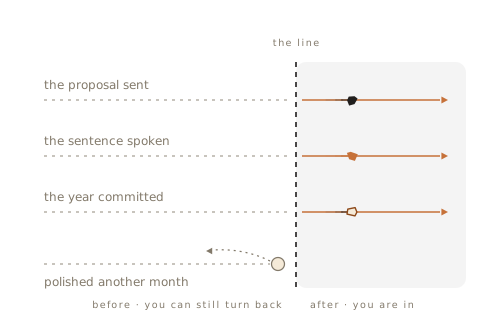
Every worthwhile thing has a threshold. The moment the proposal is sent. The moment the difficult sentence is spoken. The moment the money, or the year, or your name is committed. Before the threshold you can still turn back. After it, you are in.
Chapter 7 borrows the astronomers' term for this and calls the seventh power event horizon courage: the ability to step across the line into a situation whose outcome you cannot see, without freezing at the edge.
BEFORE THE LINE                    AFTER THE LINE
you can still turn back     ──►    you are in
the draft can be reworked   ──►    it has been read
the sentence can be unsaid  ──►    it has been heard
Notice how small the crossing usually is. A send button. Eight words. A signature. The act takes a second, and the weight of it comes entirely from the fact that it cannot be undone.
Courage is fear with ballast
The book is precise about what makes a crossing possible, and it is not bravery.
Most people do not lack courage. They lack the composure to be afraid and still step. The difference is inner weight. Someone thin and scattered at the threshold is all fear and no ballast, so the fear takes the controls. Someone gathered is still afraid, but the fear has somewhere to sit that is not the driver's seat.
This is why the seventh power, the power to face (Saamna Karne ki Shakti), is not taught first. It rests on inner mass. Trying to be brave without weight behind it is the reason so many resolutions to speak up dissolve on the way to the meeting.
Freezing at the edge
The failure the term names is not a wrong crossing. It is the crossing that never happens, and it is easy to miss because it looks like diligence.
- The proposal polished for another month instead of sent.
- The message rewritten four times and left in drafts.
- The resignation, the apology, the number never quite named out loud.
- The year of preparing to begin.
Each delay feels responsible in the moment. Together they describe potential that never converts into motion. The book's measure is blunt: before the line, nothing has happened yet, however much work went into the approach.
The practice: two minutes before
Two minutes before a hard conversation or decision, sit and pull your attention back to centre. Say silently: I am here to add clarity; I need nothing from this room. Then, when you speak, speak more slowly than feels natural.
Arriving gathered is what lets the gap stay open when the pressure arrives. Needing nothing from the room is what removes most of the fear, because most of what makes a threshold frightening is what you are hoping to be given on the other side of it.
Where the fuel comes from
Chapter 7 pairs the powers with the seven virtues of the soul, and it offers a diagnosis worth keeping.
When a power fails you, look at what feeds it. If you cannot face the threshold, it is usually peace or knowledge that has run low, not courage. Peace gives you a baseline to return to; knowledge lets you see the situation whole, so the surface does not surprise you. Trying to force courage on an empty tank is the slowest way to cross anything.
A second use: the daily event horizon
The deep version uses the term in a second sense, and the two are worth holding apart.
There, the event horizon is not out in the world but at the start of the day. The deep version of Chapter 3 describes a voluntary collapse of an identity that has run out of fuel: old titles, past mistakes and the need to be right about them are let go rather than propped up. The instruction is to treat every morning as a threshold, stripping away name, history and status before the day begins, and then asking what clean action you would take today if you had arrived with no history at all. What gets put down at that crossing are the grooves Raja Yoga calls sanskars.
Chapter 10 puts the same idea at the other end of the day, in an evening shutdown where the accounts are closed and every role is put down before sleep. In the first sense you cross a line in the world. In the second you cross one in yourself, daily, so that yesterday's debris does not come with you. What comes apart in that second crossing is described in spaghettification.
The Prime Mover stance
A Prime Mover is not someone for whom thresholds are small. The proposal matters, the sentence costs something, the year is a real year. What has changed is that the deciding happens before the edge, not at it. The approach is made with attention gathered, the line is crossed at the moment chosen rather than the moment forced, and afterwards there is no re-litigating, because a crossed horizon is not a question any more.
Related terms: Inner Mass, Spaghettification, Recovery Speed, Gravity, Prime Mover. Taught in Chapter 7: Facing Pressure and Team Harmony, with the daily sense in the deep version of Chapter 3: Resistance Is Just Data. See also the power to face among the eight powers.