A word from Raja Yoga, not from physics
Most terms in this glossary have a twin in physics. This one does not, and it is worth saying so plainly rather than inventing one.
Sanskar, usually written in the plural as sanskars, comes from the Raja Yoga tradition the author has practised for over ten years. It means an impression: a mark left on the soul by what it has already experienced, done and repeated. Your sanskars are the reason two people can meet exactly the same event and one hardens while the other softens. Nothing about the event decided that. The grooves already there did.
In everyday English the closest word is conditioning. The book uses the two almost interchangeably.
The groove
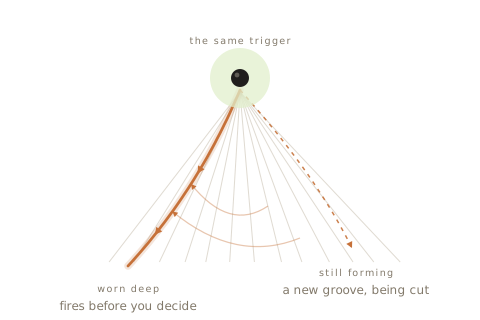
Rain falling on a bare hillside for the first time spreads out everywhere, finding no particular way down. Once some of it has cut a channel, the next rain does not choose. It runs where the channel already goes, and in running there it cuts the channel deeper.
That is the whole idea, and it is why the term is about repetition rather than character.
FIRST TIME       a choice, made slowly, with effort
TENTH TIME       quicker, and you still notice making it
HUNDREDTH TIME   no decision happens at all; the groove decides
The uncomfortable part is that nothing distinguishes a good groove from a bad one while it is being cut. Both feel like simply being yourself.
What the book does with it
The term appears in the deep version rather than the plain-language edition, and always in the same role: the thing that keeps a person acting as an effect rather than a cause.
- In the deep version of Chapter 3, the first stage of what the manuscript calls psychological rebirth is recognising that your current habits, doubts and conditioning have run out of fuel. The word in brackets there is sanskars.
- The diagram in that section describes what happens at the threshold as a total collapse of unconscious sanskars. Unconscious is the operative word. A groove you can see is already losing some of its power.
- In the passage on life at a Brahma Kumaris centre, removing harsh digital, visual and emotional inputs is described as cleansing the subconscious impressions, which ends a source of internal friction that quietly drains energy.
Put together: sanskars are what fires in the gap before you have decided anything, and the book treats reducing their grip as most of the work of becoming a prime mover.
Not the same as cosmic debris
These two are easy to confuse, and the difference decides what you do about them.
Cosmic debris is residue that is orbiting you right now: today's unfinished conversation, this week's replayed email, the loop still open from Tuesday. It is cleared nightly, and it comes back nightly.
Sanskars are not in orbit. They are the shape of the responder, laid down over years. They do not clear in an evening. They change the way a channel changes, slowly, by what runs through it.
Where you will notice yours
Not in a crisis, usually. In the small automatic moments.
- The sentence you always reach for when criticised, before you have judged whether the criticism was fair.
- The hand that finds the phone in the first quiet second of a queue, a lift, a pause in conversation.
- The apology that arrives before you have decided anything went wrong.
- Who you become in one particular room, or with one particular person, which is never quite who you are elsewhere.
Changing them
The book's stance is that grooves are not defeated by fighting them head-on. They are changed by not feeding the old channel, and by cutting a new one through repetition.
- Widen the gap. Between the event and the response there is a gap, and when it is narrow the groove fills it entirely. Everything that produces gravitational time dilation, the pull-back and the pause before speaking, buys back the fraction of a second in which a choice is possible at all.
- Watch what you feed it. The centre-life passage is blunt about inputs. What you take in repeatedly settles as impressions, so the material you read, watch and argue with is not neutral entertainment. It is what the next groove will be cut from.
- Cross the daily threshold. The deep version treats each morning as an event horizon: name, history and yesterday's mistakes put down before the day starts, so that the day is not simply a continuation of the groove. Chapter 10 does the same at night, closing the accounts and putting down every role.
- Repeat the new one. A new channel is cut exactly the way the old one was, by water going down it again and again when it would rather go the old way. This is slow, and it is the only method the book offers.
What this is not
It is not fate. Sanskars describe a tendency, not a destiny. The entire point of naming them is that they can be re-cut.
It is not a moral scorecard. In the book's framework karma is immediate feedback about how you are operating now, not a tally kept somewhere against you. Sanskars belong to the same picture: engineering data, not a verdict.
It is not a claim about the brain. The manuscript does not make one, and neither does this page. If the Sanskrit is not for you, read the word as conditioning and nothing is lost.
The Prime Mover stance
A Prime Mover has grooves like anyone else. Decades of repetition do not evaporate because someone has read a book about attention. What changes is that the groove stops being the decider. The trigger arrives, the old channel offers itself, and there is now enough room, and enough weight at the centre, for something else to be chosen. Do that often enough and the new channel is the deep one.
Related terms: Cosmic Debris, Event Horizon, Singularity, Recovery Speed, Prime Mover. Used in the deep version of Chapter 3: Resistance Is Just Data, and worked on daily in Chapter 10: The Daily Routine.