The physics of a singularity
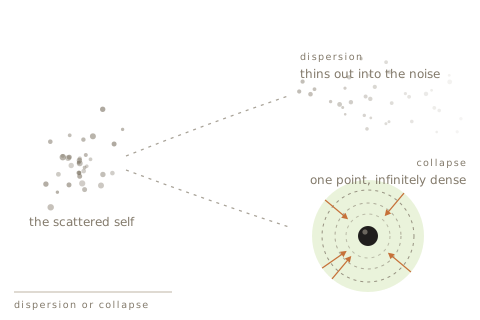
When a massive star exhausts its fuel, it faces two possible endings. It can disperse, thinning out into the space around it until nothing of it is anywhere in particular. Or it can collapse: its own gravity pulls every particle inward towards a central point, and the matter that once filled a vast volume is concentrated into an almost unimaginably small one. That endpoint is called a singularity.
Two properties matter here. A singularity does not fight the space around it. It does not argue, defend, or scramble for control. It simply has so much mass in so small a place that space itself bends around it, and everything nearby follows the curve.
One honest note, because the book is careful about this elsewhere. In physics, a singularity is also where the equations stop producing sensible answers, which most physicists read as a sign that the theory is incomplete rather than as a description of a real object. The book uses the word as a picture of maximum concentration, not as a claim about the mechanics of a mind.
The state the book is named for
The Inward Singularity takes its title from this. The front matter puts the invitation plainly: pull your scattered awareness back from the noisy edges of your life and anchor it in an unshakeable point behind your eyes.
DISPERSION                        COLLAPSE
the same you, spread outwards     the same you, pulled to one point
thin everywhere, present nowhere  dense, quiet, hard to move
the world runs through you        the world bends around you
Three things follow when the centre of gravity moves from outside to inside, and each has its own page here. Friction drops, because there is less reacting, defending and mental chatter to pay for. Steadiness stops depending on the weather, because outside opinions and sudden crises lose their grip on the baseline. And action starts coming from you rather than from whatever arrived last, which is the state the book calls prime mover.
Dispersion or collapse
The fork is the useful part of the picture, because both endings involve the same amount of you.
Dispersion is not a dramatic failure. It is the ordinary result of letting attention go wherever it is pulled, which the book calls entropy. Nothing is lost on any single day. It simply ends up spread so thin that no part of your life gets a version of you that is really there.
Collapse, in this metaphor, is the good outcome. It is what gravity produces when the daily return to centre is actually practised, and what density measures once it has been. The word sounds like breakdown and means the opposite: everything, gathered, in one place.
Not built, only uncovered
The deep version makes a claim that changes the work considerably. The singularity is not created by effort. It is already there, underneath.
That reframes the task. You are not required to invent a self, assemble one from advice, or earn one through achievement. The work is removal: the stripping away of borrowed roles and expectations until what was always underneath is uncovered again. In the book's language this is ontological subtraction, and it is why the practices ask you to put things down rather than take more on.
For many readers this is the most relieving idea in the book. The pressure to construct a self is enormous, and it is also unnecessary.
The vessel and the signal
The deep version draws one careful distinction, and it is worth stating clearly because it prevents a cruel misreading.
The vessel is the biological hardware: the body, the brain chemistry, the genetic inheritance, the nervous system. Vessels vary enormously. They carry illness, injury, inherited conditions and the effects of what has happened to them. That is real, and the book does not pretend otherwise.
The singularity is the awareness inhabiting that vessel, the quiet witness behind the senses. The picture the manuscript uses is a radio. A receiver may have a cracked case, a frayed wire or a stiff tuning dial, and the broadcast itself is unaffected by any of it. The hardware shapes how the signal comes through into the world. It does not degrade the signal.
So purity, in this sense, has nothing to do with being physically perfect, healthy or impressive. It means untouched, and it holds regardless of the condition of the vessel.
Two singularities
There is a second use of the word in the book, and keeping them apart makes both clearer.
One is the point you are: the gathered centre behind your eyes. The other is the point you connect to. In the Brahma Kumaris tradition the author practises, the Supreme Soul is described as an incorporeal point of light, uncreated and outside the cycle of decay. Chapter 2 makes the practical case for needing a reference that does not move, and this is the author's own fixed point.
The two work together. The daily connection in the quiet early hours is what the deep version treats as charging: your own centre is anchored to something that cannot drift, and steadiness is drawn from there rather than requested from the room you happen to be in. If that language is not yours, Chapter 2 is explicit that the principle still holds with a different anchor. What matters is that it does not move.
How you approach it
There is no single act that produces this state, which is why the book is a routine rather than an argument.
- The pull-back. Thirty seconds, attention drawn home from wherever it has gone. The smallest unit of collapse.
- The morning anchor. A few screen-free minutes at the start of the day, connecting to the fixed point before anything else gets a vote.
- The subtraction. One role, opinion or commitment put down each time you notice it is being carried for appearances.
The Prime Mover stance
A singularity does not need to push. That single sentence carries most of the book's argument about power. Force is what you reach for when you are thin and need the outside world to move; mass is what makes movement happen around you without any reaching at all. A person gathered to a point is not louder, faster or harder than anyone else in the room. They are simply harder to move, and after a while, the room arranges itself accordingly.
Related terms: Inner Mass, Density, Gravity, Ontological Subtraction, Prime Mover. The idea is set out in the book's opening pages, on the book page, and developed in Chapter 2: The Unshakeable Centre and Chapter 11: Uninterrupted Sovereignty.