The physics of subtraction
Rocket engineers face a hard rule. To go faster you need fuel, but fuel is heavy, so adding fuel only helps up to a point. The way rockets actually reach orbit is by dropping weight: the empty tanks are jettisoned mid-flight, stage by stage. The lighter the vehicle, the further the same push takes it. The equation that governs this, Tsiolkovsky's rocket equation, says that the most effective way to gain velocity is not more propellant but less dry mass.
The Inward Singularity applies this to a life. Most productivity advice is additive: a new app, a new routine, a new system to organise the old ones. Each addition helps for a week and then becomes one more thing to carry. Ontological subtraction is the opposite move. In plain words: ruthless simplification. You get more speed not from a bigger engine but from a lighter load.
The word ontological simply means "to do with what you are". The subtraction is not of tasks but of identity: the roles and expectations you carry around all day without noticing their weight. What is left when enough has been put down is what the book calls the singularity.
The five kinds of weight
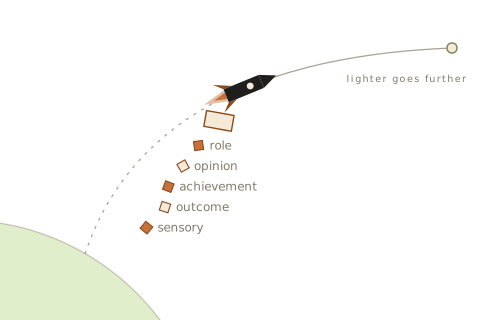
Most of the load is invisible, because it is not on the calendar. The book names five drag layers. Each has a question that exposes it.
Role weight          "Would I still do this if no one knew my title?"
Opinion weight       "Does this argument change anything I do tomorrow?"
Achievement weight   "Am I doing this for the outcome or the applause?"
Outcome weight       "Which part of this is actually mine to decide?"
Sensory weight       "Did I choose to look at that, or did it choose me?"
Notice that none of these are tasks. You cannot delegate or schedule them. You can only put them down. And every "yes" given against your own judgement adds to at least one of them: a role you did not want, an outcome you are now responsible for, an opinion you will now have to defend.
Why subtraction creates strength
Spread a fixed amount of butter over ten slices of bread and each gets a scrape too thin to taste. You have not gained nine slices; you have lost the one you had. You are a fixed amount of attention. Ten commitments do not make you a person with ten times the life; they make you a person spread over ten surfaces, thin at every one.
Subtraction reverses this. The same you, spread over less, goes deeper, and density is what makes a person hard to knock over. This is why the book insists that saying no does not shrink a life. It concentrates one.
The purge-and-protect sort
A simple way to run the subtraction on a week is two columns.
Purge, high drag and low value: meetings attended to be seen; chat channels that cannot be left open without checking; social obligations kept out of guilt; projects kept alive to prove a point.
Protect, low drag and high value: uninterrupted blocks on the one thing that matters; rest, and the morning minutes before any screen; the two or three relationships that give energy back; work you would do even if no one noticed.
Everything in the first column is fuel being burned to carry weight you do not need.
The smallest practice
Sit quietly for a minute and bring your current commitments to mind, not as a list but as a feeling. Find one that exists mainly because of role weight or opinion weight, one you said yes to in order to be seen a certain way. Decide, silently, that it is going. You do not have to send the email yet. Notice the small physical relief. That is the sensation of dropped weight, and it is available every day.
The Prime Mover stance
A Prime Mover does not build authority by adding status, systems and possessions to a fragile self. They strip away everything that is not load-bearing until only the dense, causal core remains, and then the same push that used to move nothing carries them a long way.
Related terms: Inner Mass, Cosmic Debris. Taught in Chapter 4: The Art of Letting Go and Chapter 9: Depth Over Breadth.