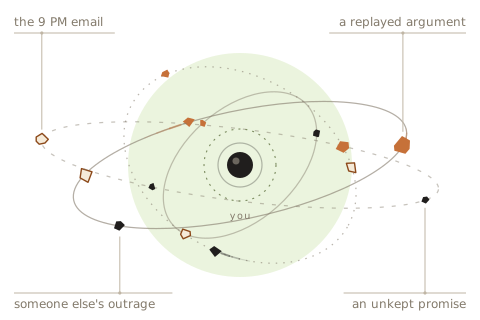
The physics of cosmic debris
In astrophysics, space is far from empty. Decades of satellite launches, rocket stages and broken equipment have created thousands of orbiting fragments known as space debris. A paint fleck travelling at orbital velocity can punch through a hull as lethally as a missile. The danger is not merely the size of the object, but its persistent, unmanaged velocity around the vehicle.
In human consciousness, cosmic debris works identically.
When you live on the periphery of your life, you continually generate micro-fragments of unresolved mental matter:
- The half-written email you keep replaying at 9:00 PM.
- The defensive argument you staged in your mind after a tense meeting.
- The ambient guilt of unkept commitments and minor distractions.
- The urge to react to distant political outrage or social media chatter.
Individually, these fragments seem harmless. Collectively, they form a dense cloud of friction orbiting your centre of awareness.
Why debris causes exhaustion
You do not get tired simply from working hard; you get tired from running your engine through a storm of your own accumulated debris.
[ PERIPHERAL ATTENTION ] ──► Creates Open Loops ──► Forms Orbital Debris
                                                            │
                                                            ▼
[ CORE GRAVITY DROPS ]   ◄──  Consumes Energy   ◄──  Continuous Drag
Every unclosed loop and unresolved emotional fragment requires active processing power to maintain. When your attention is scattered across dozens of orbiting distractions, your inner mass drops. You become thin, fragile and easily knocked off course by the next environmental wind.
Clearing the field: the debris protocols
You cannot clear cosmic debris by chasing down every fragment individually. Trying to solve every minor worry is like trying to catch space junk with a butterfly net.
Instead, you clear the field through core gravity and systemic closure.
1. Increase your inner mass (gravitational sweeping)
A high-density core naturally reorganises its surrounding field. When you perform the morning anchor and pull your scattered awareness back behind your eyes, you drop your exposure to peripheral noise. Smaller distractions lose their gravitational pull over you.
2. Ontological subtraction (dropping weight)
Stop adding new management systems to cope with the clutter. Ask yourself: is this incoming demand signal or noise? If it does not alter what you will do this week, let it pass.
3. Real-time closure (closing the loops)
At the evening shutdown, perform a ruthless sweep:
- Record the facts. Write down unfinished tasks so your mind stops holding them in orbit.
- Sever the replay. Recognise that replaying a past interaction generates immediate inner drag, which is what the book means by karma. Drop the narrative and keep only the data.
- Reset to baseline. Disconnect cleanly from all roles before sleep.
The Prime Mover stance
A Prime Mover does not navigate life through a cloud of yesterday's debris. Every morning is an empty space and a clean slate.
When you clear your inner orbit, friction drops to zero. You regain the depth, focus and quiet authority required to shape your trajectory rather than reacting to the noise.
Debris is what entropy leaves in your orbit. Read more terms in the glossary, or see the practice in Chapter 10: The Daily Routine and the weight-dropping in Chapter 4: The Art of Letting Go.