The physics the book borrows
Engineers do not get angry at friction. They measure it. When a machine runs hot, the heat tells them exactly where two parts are rubbing. It is a signal, not an insult.
The second borrowing is Newton's third law: every action has an equal and opposite reaction. The book applies it inwards rather than outwards. Whatever you send out, you are the first thing it acts on. The deep version puts it as a single line: every thought, choice and emotional emission alters your own baseline before it reaches anybody else.
Not a ledger
This is the move the book makes, and everything else follows from it.
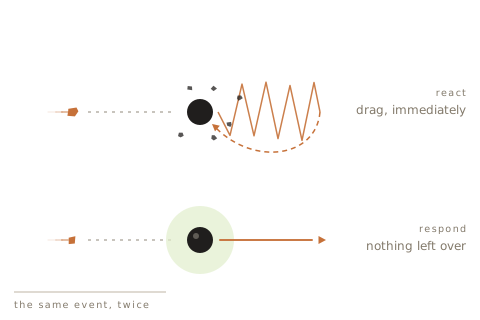
The Raja Yoga tradition has a word for the way your actions shape your inner state: karma. In the manuscript it is treated not as a tally kept somewhere else, and not as a bill arriving in some later life, but as immediate physics. In plain words: when you react with blame, defence or resentment, you pay for it straight away, in the form of inner drag.
The deep version is blunter still. The cost of acting badly is not a future punishment. It is the loss, right now, of the steadiness you had a moment ago.
THE OLD READING            THE BOOK'S READING
a ledger kept elsewhere    immediate feedback
settled later              settled now
about deserving            about operating
That is a smaller claim than the usual one, and a more useful one. It can be checked. Snap at someone this afternoon and watch what happens to the next hour of your own attention.
The message and the replay
Chapter 3 teaches this through a pothole.
You hit one on the way to work. It jolts the car, you spill a little coffee, and for the next ten minutes you replay it: the council should have fixed that, you should have seen it, this is typical of your week. Now look at what the pothole actually told you. There is a hole in the road at that spot. That is the whole message. Everything else you added.
| What happened | The message | The replay you added |
|---|---|---|
| A critical comment in a meeting | One person sees a weakness in the plan | "They never respected me. Everyone saw." |
| A project is cut | Priorities changed above you | "Three months wasted. This always happens to me." |
| A late train | You will arrive twenty minutes late | Twenty minutes of fury at the rail company |
The chapter's estimate is that most people spend about ninety percent of their energy on the replay rather than the message. Its summary line is the one worth keeping: the replay is the bill. Stop paying it.
High friction and none
The deep version sorts actions by what they leave behind in you.
High friction. Justifying something you know is not true, harbouring a small resentment, deciding out of fear, defending a position because it is yours. Each one introduces drag, the way a slow leak does in a pressure vessel. Nothing dramatic happens. You are simply lighter and less steady afterwards than you were before, and the loss is immediate.
No friction. Acting with no defence, no hesitation and nothing hidden. The action completes, and there is no residue: nothing to replay tonight, nothing to justify tomorrow, nothing left circling. You are exactly as steady after it as before.
Notice that neither category is about how difficult the action was, or how others judged it. Hard, unpopular and frightening acts can be frictionless. Small, socially rewarded ones can be expensive.
The deferred-living trap
The manuscript names one error twice, in two different costumes.
The religious version says: endure quietly now, and a better state will come later. The secular version says: endure this job, this manager, this compromise, and once the milestone arrives you will finally be free to act like yourself. Both treat today's self as the inevitable product of what has already happened, and both postpone the only moment in which anything can actually change.
The book's answer is that if karma is immediate, so is the remedy. Nothing has to be earned back before you can act cleanly. The next action is available now.
The three-step reset
When something lands hard, Chapter 3 gives a sequence. It works the same whether the shock is an angry email or a genuine crisis.
- Sever the reaction. Do not speak or act for five seconds. Force a physical pause. The noise of an event is not the same as its content.
- Return to centre. Pull attention back from the surface of the event to the place behind your eyes, and remember that it cannot set your inner state unless you hand it over.
- Respond cleanly. Address the actual situation with no defence and no attack. Say what is true, say what you will do, and add nothing about how you feel about it.
Step three is where the energy goes. The ninety percent that funded the replay now funds the fix.
How it connects
Recovery speed is the measurement that goes with this idea. The manuscript calls it latency to zero: how long it takes to return to baseline after a knock. Reacting lengthens it; responding cleanly keeps it short.
Cosmic debris is what an unpaid replay becomes once the day has moved on. The reaction ends; the loop it opened stays in orbit.
Sanskars are why the expensive response is so often the automatic one. The groove was cut by every previous time you took it.
The Prime Mover stance
Chapter 11 states the first of its three laws as inner causality: nothing outside you has power over your inner state unless you hand it over. Karma, read this way, is simply the meter on that. It tells you, immediately and honestly, whether the last thing you did was launched by you or dragged out of you. A prime mover reads that meter without guilt, because it is not a verdict on their character. It is engineering data about the last five minutes, and the next five are unspent.
Related terms: Recovery Speed, Cosmic Debris, Sanskars, Inner Mass, Prime Mover. Taught in Chapter 3: Resistance Is Just Data, with the law of inner causality in Chapter 11: Uninterrupted Sovereignty.