The physics of recovery speed
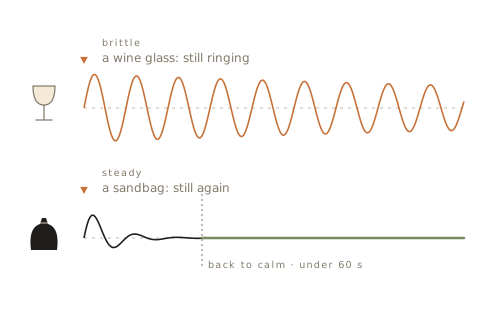
Strike a wine glass and it rings. Strike a sandbag and it goes quiet at once. Both were hit with the same force. The difference is damping: how quickly a system absorbs a disturbance and returns to rest. Engineers design for it deliberately, because a structure that keeps vibrating after every knock eventually shakes itself apart.
The Inward Singularity borrows the idea for the mind and calls it, in the original manuscript, latency to zero. In plain words: recovery speed. Not how often you are knocked, which is largely outside your control, but how long it takes you to be still again afterwards, which is not.
Why it is the measure that matters
Most people track the wrong thing. They count how many things went wrong in a day and conclude they had a bad one. The book asks a different question: after the worst interruption today, how long until you were calm again?
brittle (low mass):   /\/\/\/\/\/\/\/\/\/\/\   still ringing hours later
steady  (high mass):  /\_                       back to baseline in seconds
A brittle system rings for hours or days: the remark replayed at 9:00 PM, the argument re-staged in the shower, the email reread on the train. Every minute of that ringing is energy spent on the past and unavailable for the present. A steady system takes the hit, absorbs it, processes what is useful, and is quiet again almost at once.
This is why recovery speed is a better guide than resilience. Resilience sounds like never being knocked. Recovery speed admits you will be knocked, often, and measures the only part you can train.
The target: sixty seconds
The book sets a specific number. Not never being disturbed, but being back at baseline within one minute of any provocation, from a rude email to a genuine crisis. It is a skill, and like any skill it improves with repetition. Most people, measuring honestly for the first time, find their recovery runs to hours. Within weeks of practice it drops to minutes. Sixty seconds is reachable.
The three-step reset
When something lands hard, the sequence is the same whatever the size of the shock:
- Sever the reaction. Do not speak or act for five seconds. Force a physical pause. The noise of the event is not the same as its content.
- Return to centre. Pull attention back from the surface of the event to the place behind your eyes. Say silently: I am the one watching this. It cannot set my inner state unless I hand it over.
- Respond cleanly. Address the actual situation with no defence and no attack. Say what is true, say what you will do, and add nothing about how you feel about it.
Step three is where the recovered energy goes. The ninety percent that used to fund the replay now funds the fix.
Measuring it
At the evening shutdown the book asks you to score four measures, and recovery speed is one of them. Signed-in readers track it on the site with a nightly one-to-five score, and the thirty-day average is shown on the Today page. Watching that number move is more motivating than any resolution.
The Prime Mover stance
A Prime Mover is not someone nothing happens to. Things happen to them all day. The difference is that an hour later they are exactly as heavy as they were before, because the shock was absorbed rather than carried. Friction is read as data, the account is closed, and the day continues from the centre.
Related terms: Gravitational Time Dilation, the same steadiness in the moment itself; Inner Mass, Cosmic Debris. Taught in Chapter 3: Resistance Is Just Data and tracked in Chapter 10: The Daily Routine.