The physics of time dilation
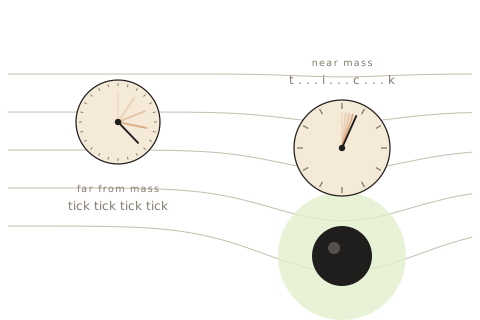
Einstein's general theory of relativity predicts something that sounds like fiction and turns out to be measurable: a clock closer to a heavy object ticks more slowly than an identical clock further away. The heavier the object, and the closer the clock, the larger the difference.
On Earth the effect is tiny, but it is real. Clocks on the satellites that provide GPS sit further from Earth's mass than clocks on the ground, so they run very slightly fast, by a few tens of millionths of a second each day. Without a correction for it, satellite navigation would drift by kilometres within a day. Time does not pass at one universal rate. It depends on where you are standing in relation to mass.
The picture the book takes from it
The Inward Singularity borrows this as a picture, and it is worth being clear about what that means. Being calm does not make a physical clock tick slower. What changes is the experience of time, and the space inside it.
The book's claim is this: the more inner mass you have, the slower and more spacious a crisis seems to unfold around you. When your attention is scattered you are light, and time feels like an enemy, a rushed blur in which you react within a fraction of a second to whatever is loudest. When your attention is gathered you are heavy, and the same events arrive with space between them.
OUTSIDE CLOCK (scattered):   [ TICK . TICK . TICK . TICK ]   fast, frantic
INNER CLOCK  (gathered):     [ T . . . I . . . C . . . K ]   spacious, slow
The deep version of Chapter 8 writes the relativity equation out in full, with internal mass in place of physical mass. Read it as the book intends: a precise-looking metaphor for an experience that is otherwise hard to describe, not a law of neuroscience.
"The game slowed down"
Ask an experienced athlete what changed as they improved, and many say the same odd thing: the game slowed down. The ball did not move more slowly. The other players did not tire sooner. Something in the athlete's attention changed, and a situation that used to be a blur became a series of separate moments with room to choose between them.
Pilots, surgeons, emergency workers and experienced drivers describe the same thing. Their best moments under pressure feel strangely unhurried. That is the everyday version of this term.
The gap is where you live
Between something happening and your response to it there is a gap. For most people it is very short, and filled entirely by reflex. The insult arrives; the defence leaves. The email lands; the reply is half-written before the message has been read to the end.
Every practice in the book does the same thing at this level: it widens that gap. The pull-back, the morning anchor and the three-step reset all create a little more space between stimulus and response. And that space is where every good decision is made. Widen it, and a crisis stops being one blurred event and becomes a sequence of moments, each with room for a choice.
| Same event | Narrow gap (scattered) | Wide gap (gathered) |
|---|---|---|
| A sharp question in a meeting | Defensive answer before the question has finished | A breath, then "Good question. Here is what I know." |
| A system goes down | Ten messages in two minutes, three of them wrong | Thirty seconds to see the shape of it, then one clear instruction |
| Bad news at home | The first sentence is the one you regret | Silence long enough to choose the first sentence |
Nothing outside slowed down. The gap inside got wider.
Widening the gap: three practices
1. The count of three
For one day, whenever you feel the urge to respond to anything, count silently to three first: emails, questions, comments, notifications. From outside it looks like nothing. From inside it feels like a long time. At the end of the day, notice how often the pause changed what you said, and how much slower the day felt.
2. Gather before pressure
Two minutes before a hard meeting or decision, sit and pull your attention back to the centre. Arriving gathered is what gives the gap room to open when the pressure comes.
3. Speak more slowly than feels natural
Pace is contagious in both directions. Slowing your own speech slows your breathing and your reactions, and it lets the room fall into your rhythm rather than you falling into its.
How it connects
Time dilation is what recovery speed looks like before a shock rather than after it. Recovery speed measures how fast you return to calm; time dilation describes how much room you had in the moment itself. Both come from the same source, inner mass, and both improve together.
The Prime Mover stance
A Prime Mover does not have more hours than anyone else. They have more room inside each one. When pressure arrives, the room around them seems to hurry and they do not, and from that unhurried place the next action is chosen rather than triggered.
Related terms: Inner Mass, Recovery Speed, Density, Prime Mover. Taught in Chapter 8: How to Slow Down Time.