The name
Jeevan Mukti is the Raja Yoga term for liberation while living, as against a liberation that waits for some later state. The Inward Singularity takes it as its destination and translates it in one line: still at the centre, fully active in the world.
The three words that follow, in the book's own phrasing, matter as much as the definition. Not retreat. Not detachment in the cold sense. Presence, with the weight underneath it.
Surface and deep
Chapter 11 gives the picture the whole book has been building towards.
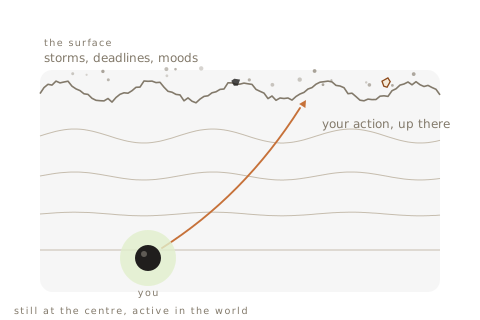
On the surface of the ocean, wind makes waves, storms make bigger ones, and nothing is ever still. A few metres down there is still movement. Ten thousand metres down there is absolute quiet. The storm on the surface is real, and it does not reach.
SURFACE   chaos, outrage, noise, urgency
─────────────────────────────────────────
DEEP      stillness, steadiness, full weight
The person the book describes has not stopped the waves. Nobody stops the waves. Their centre of weight has dropped so far below the surface that the waves are no longer where they live.
Not an afterlife, and not a retreat
The deep version is unusually direct about this, and it rules out two comfortable misreadings at once.
It is not a religious ideal held out for later. The manuscript calls it an operational threshold, and defines it as the engineering state of zero internal friction while doing work in the physical world. The test is today, not afterwards.
It is also not withdrawal. The passage is explicit that you carry on building things, managing crises, handling relationships and executing complex work. What changes is that your peace, your energy and your sense of authority can no longer be taken hostage by any of it. Liberation here means free while working, not free from working.
What it is made of
Nothing on this page is a new practice. The state is what the existing ones produce when they are kept.
- Inner mass is the weight that puts your centre below the waves.
- Gravity is the daily return that keeps it there.
- Recovery speed is how quickly the surface stops mattering after a knock, and the deep version tracks it alongside three other daily measures.
- Singularity is the same destination described from the other side: everything gathered to one point.
The deep version treats this as a threshold reached by consistency rather than a prize awarded for effort. Keep the measures in good order over time, and the state is simply where you end up living.
The three laws that hold it
Chapter 11 reduces the whole book to three rules, short enough to keep.
| Law | In one line |
|---|---|
| Inner causality | Nothing outside you has power over your inner state unless you hand it over |
| Zero friction | Force is the weapon of the weak; weight is the tool of the steady |
| Continuous release | Holding on to the past is the end of original action |
The first takes the weight back the moment you catch yourself blaming a person or an event. The second meets opposition with stillness and clear intent rather than more noise. The third leaves yesterday's wins and wounds in yesterday.
What it looks like from outside
The book is careful that this is not a calmer person sitting alone in a quiet room.
When a family is frightened, when a team is in the middle of a failure, when the news is bad and everyone is talking at once, most people are carried by the surface. The person with weight underneath is not. They become the fixed point the others measure against, and the tempo the room falls into. They do not have to say anything about it.
That is what the manuscript means by authority, and it is nothing like the loud kind. It is quiet, it cannot be taken away, and it was never given by anyone else.
The Prime Mover stance
Prime mover names what such a person does: they cause their day rather than react to it. Jeevan Mukti names what it is like from the inside while they do it. The two are the same state seen from two directions, which is why the book ends on this one. The last line of the argument is not a technique. It is that the work stops feeling like work, because being steady has stopped being something you do and become the thing you are.
Related terms: Prime Mover, Inner Mass, Singularity, Recovery Speed, Gravity. Taught in Chapter 11: Uninterrupted Sovereignty, and produced by the routine in Chapter 10: The Daily Routine.