The name
Traffic Control is the Brahma Kumaris name for the practice, and the manuscript keeps it. The image is of stopping the flow briefly and deliberately, at regular intervals, so that nothing builds up behind it.
The plain-language edition uses a different word for the same thing. Chapter 10 calls them midday pauses, and describes them as micro-retractions: the tortoise from Chapter 1, briefly. If the traffic image does not help you, that one will.
The problem it solves
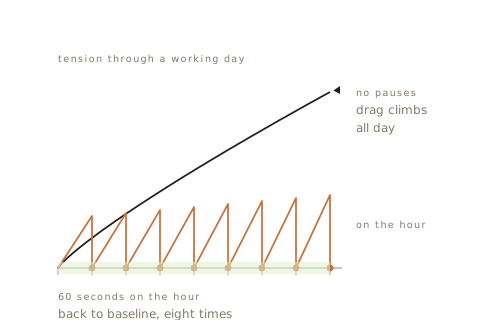
Tension accumulates through a working day whether or not anything goes wrong.
That sentence is the whole case for the practice. Most people wait for a reason to stop, so the first pause of the day arrives only after something has already gone badly. By then the drag has been building for hours, and what could have been sixty seconds of maintenance has become an evening of recovery.
NO PAUSES                     ON THE HOUR
tension climbs all day        climbs, then back to baseline
one reset, in the evening     eight resets, sixty seconds each
you end the day empty         you end it roughly where you started
The three steps
Both versions of the book give the same sequence, and it fits inside a minute.
- Stop. Step back into the watcher.
- Scan for drag. Tension held in the body, a reply being composed in your head, something you are over-explaining to yourself.
- Drop it. One deep breath, return to the line you wrote this morning, and re-enter the work from zero.
The deep version adds one question to the scan: is there any subtle heaviness, doubt or expectation leaking away my steadiness right now? It calls this an hourly telemetry check, which is to say a reading taken on purpose rather than a feeling waited for.
Audit by friction, not by fault
The deep version is specific about what you are looking for, and it matters, because a pause spent judging yourself is worse than no pause at all.
You are not asking whether the last hour was good or bad. You are asking whether anything in it is adding drag: energy leaking into defence, into proving something, into turbulence that has already served its purpose. If the answer is yes, the loop is ended there rather than carried. This is the same stance the book takes on karma, where a reaction is read as immediate cost rather than as a verdict on your character.
The manuscript also names what it is hunting. Not rage or catastrophe, but the low-grade material underneath: doubt, self-mistrust, quiet comparison, hesitation. Its image is a pressure vessel with microscopic leaks, unnoticed for a long time and reliably destructive in the end.
Where it sits in the day
The routine has three phases, and this is the middle one.
Amrit Vela sets the direction before anything arrives. Traffic Control keeps you near that direction while the day does its work, which is why step three returns to the line written that morning rather than to a general sense of calm. The evening shutdown closes the accounts so nothing carries into tomorrow.
Two habits in Chapter 10 belong to the same middle phase. Do the most important work in blocks of about ninety minutes with everything else closed, and handle messages in two fixed windows rather than continuously. The reason the book gives for the second one is precise: checking messages all day subjects you to a small shock every few minutes, and each one costs recovery time.
What it is not
It is not a break. Nothing is consumed, read or scrolled. A pause spent on a screen is another input, not a retraction.
It is not sixty seconds of thinking about the problem. The scan looks at your own state, not at the work. Solving is what the other fifty-nine minutes are for.
It is not dependent on things going wrong. The pause happens on the hour whether the hour was calm or awful. That is what makes it maintenance rather than repair.
The Prime Mover stance
A day with eight small returns in it looks, from outside, exactly like a day without them. Nothing is announced and almost no time is spent. What differs is the shape of the evening. One person arrives at it carrying everything the day deposited, and reads that weight as proof the work is too much. The other arrives roughly as they started, because the load was put down eight times on the way, a minute at a time. This is gravity in its smallest practical unit: not one heroic return, but the habit of never drifting far.
Related terms: Amrit Vela, Recovery Speed, Karma, Cosmic Debris, Gravity. Taught in Chapter 10: The Daily Routine, with the pull-back it is built on in Chapter 1: Why You Feel Scattered. The full routine is set out on the daily protocol section of the home page.