The name and the plain version
Amrit Vela is the Raja Yoga name for the early morning hour set aside for silence and connection to the Source. The Inward Singularity keeps the name and the purpose, and then says what it means in ordinary words: the first minutes of the day belong to you, not to your phone.
The book's own front matter puts the traditional window at roughly four to five in the morning. Chapter 10 is less prescriptive, asking for fifteen to thirty minutes on waking, before any screen. The deep version asks for thirty to sixty. What none of the three versions negotiates is the rule underneath them.
Zero input
The rule is that nothing comes in first. No screens, no news, no messages. Chapter 10 calls this the single most important rule in the chapter, and the deep version states it as the whole condition of the window.
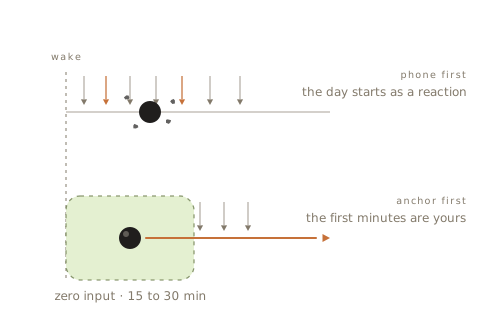
The reason is a claim about order rather than virtue. Whatever reaches you first sets the terms. Open the phone on waking and the day's first decision has been made by whoever sent the first message, and everything after it is a response. The deep version puts the aim as charging the day before a single outside force has been allowed to act.
PHONE FIRST                     ANCHOR FIRST
the first message decides  ──►  you decide
the day is a response      ──►  the day has a direction
you arrive already behind  ──►  the world arrives second
The four steps
Chapter 10 gives the morning anchor as four movements, in order.
- No input. No screens, no news, no messages.
- Put down yesterday. Titles, unfinished arguments and old worries do not come through the door with you. Sit for a few minutes as the watcher.
- Connect to your fixed point. In whatever form that takes for you.
- Write one line. The single thing that, if it moved today, would make the day a success.
Then, and only then, open the phone. The book's line for what happens next is worth keeping: the first message lands on a person who has already decided what today is for.
Why the connection is the point
It would be easy to read this as a productivity habit with an unusual name. The book does not.
Inner mass is what makes a person hard to move, and the deep version argues that mass on its own is not enough. Its image is a battery: mass without connection is a full battery with no charger, which works until it does not, and connection without mass is a charger with nothing to charge. This hour is where the two are brought together, which is why the eight powers are described as received in it rather than manufactured by effort.
Chapter 2 supplies the practical half of the same idea. You cannot steady yourself against something that moves, so the anchor needs a reference that does not. In the author's tradition that fixed point is the Supreme Soul, described as a point of light. Chapter 2 is explicit that the principle holds with a different anchor, as long as it does not move when the numbers do.
What the hour is not
It is not an alarm clock rule. The traditional window is early, and the book's plain version asks for the first minutes of your morning, whenever that morning starts. Sleep is not the enemy of this practice.
It is not planning. Nothing on the list is a task review, an inbox triage or a schedule. One line is written, and it is about direction rather than volume.
It is not only for people in the tradition. The name comes from Raja Yoga, and the four steps work whether or not the fourth one is addressed to anyone.
The rest of the day hangs on it
The daily routine has three phases, and the two later ones both refer back to this one. The midday pauses are sixty seconds each, and what they return to is the line written this morning. The evening shutdown closes the accounts so that tomorrow's window opens on a clear desk rather than on yesterday's debris.
This is also the most concentrated form of gravity, the daily return to centre. Every other return during the day is a small one. This is the one that sets where the centre is.
The Prime Mover stance
A prime mover does not win the morning by being busier in it. The hour has almost nothing in it: no output, no messages, no plan. What it produces is a person who has already chosen, before anything arrived, what the day is for. Everything that arrives afterwards meets that person rather than making them.
Related terms: Gravity, Inner Mass, Singularity, Cosmic Debris, Prime Mover. Taught in Chapter 10: The Daily Routine, with the fixed point it connects to in Chapter 2: The Unshakeable Centre. The full routine is set out on the daily protocol page.